The Mantis X sits in a product category that barely existed five years ago: electronic training aids that claim to make your dry fire smarter. You mount a small sensor to your gun’s accessory rail, run the app on your phone, and it analyzes your trigger press cycle, scoring each shot and telling you what went wrong.
Mantis makes three models. The X2 ($99.99) is dry fire only. The X3 ($169.99) adds live fire capability. The X10 Elite ($249.99) adds recoil analysis, holster draw tracking, multi-target drills, and shooting-on-the-move analysis. For competition shooters, the X10 Elite is the only model worth discussing, the features it adds over the X3 are the ones that matter most for match preparation.
One thing to understand up front: the Mantis X measures muzzle movement at trigger break. It does not measure where your bullet actually hits. It tells you what your gun did during the trigger press, not what happened downrange. That distinction matters more than you’d think, and I’ll get into why.
How I’ve Used the Mantis X: Almost 4 Years Across 6 Platforms
I bought the X10 Elite in March 2022. For the first few months, I used it daily, working through the guided training drills in the app, tracking my scores, and running it across every competition pistol I own.
That’s six platforms total: my Staccato P (primary competition gun at the time), Sig P320 Legion, Sig 1911 Max Michel, Springfield XDM, an Atlas Nemesis demo, and now my OA Defense 2311 Pro Elite. Running the Mantis across different guns with different trigger characteristics, grip angles, and recoil impulses is where I got the most value, it showed me how my grip was inconsistent from platform to platform and gave me specific feedback to work with.
I also own the Mantis Laser Academy kit and use the Pink Rhino laser cartridge for visual feedback during dry fire. The laser cartridge shows where your “shot” would land; the Mantis sensor shows why it landed there. Used together, they give you both the symptom and the diagnosis.
After those first few months of intensive daily use, my sessions became less frequent. That’s probably a realistic trajectory for most shooters, the novelty wears off, you internalize the feedback, and the device goes back in the drawer until you feel like you need a diagnostic check. I still pull it out periodically, but I’m not running it daily anymore.
What the Mantis X Does Well for Competition Shooters
Grip diagnostics across platforms. This is the single biggest value I got from the Mantis X. Running it on six different competition pistols showed me where my grip was inconsistent, different guns exposed different problems. The Mantis feedback helped me refine my grip into something that translated across platforms rather than one that only worked on my primary gun. For competitors who switch between divisions or run multiple firearms, this is genuinely useful data.
Trigger control diagnosis. The shot trace, a visual representation of your muzzle movement before, during, and after trigger press, shows you things you can’t feel in real time. Anticipation, jerking, pushing low-left, these show up as distinct patterns in the trace. If you’re dropping points on close targets and can’t figure out why, the Mantis will probably tell you.
Dry fire accountability. Let’s be honest: dry fire is boring. Having a score to beat and guided drills to work through makes dry fire sessions more structured and engaging. The app tracks your history so you can see improvement over time. For shooters who know they should dry fire more but struggle with consistency, the gamification helps.
Consistency tracking over time. The app stores every session and shows trends. If your scores on a particular drill are getting worse, that’s a signal. If they plateau, that’s a different signal. The data gives you something objective to evaluate rather than relying on feel.
What the Mantis X Can’t Do for Competition Shooters
This is the section that no other Mantis X review publishes. Every review talks about what the sensor does. Nobody talks about what it doesn’t do, and for competition shooters, the gaps matter.
No transition training. The Mantis X cannot measure target-to-target transition speed. In USPSA, 3-Gun, and multigun, transitions are where matches are won and lost. The Mantis doesn’t touch this skill.
No reload analysis. It cannot time or analyze your reloads. Reload speed is a fundamental competition skill, one the Mantis completely ignores.
No stage movement. It cannot replicate USPSA stage walkthrough, movement between shooting positions, or shooting-on-the-move in any way that simulates actual match conditions. The X10 Elite has a “shooting on the move” mode, but walking around your living room while pressing a trigger isn’t the same as running a USPSA stage.
Holster draw limitations. With the sensor mounted on the accessory rail, you can’t holster the gun. Mantis offers a short pic rail segment with 3M tape that attaches to a magazine baseplate so the sensor clears the holster. I tried this. The metrics were inconsistent, the magazine bouncing around in the magwell during movement and trigger manipulation produced readings I couldn’t trust. For competition shooters working on draw-to-first-shot, this is a real limitation.
No shot timer integration. The Mantis tracks cadence between shots, but that data doesn’t correlate to actual split times on a shot timer. Your Mantis cadence score and your actual Bill Drill time are measuring different things.
No reload, no transitions, no movement, inconsistent holster data. For a competition shooter, those are four of the five skills that matter most on a stage. The Mantis addresses one, trigger control, and addresses it well. But it’s one slice of the pie.
Does Mantis X Training Actually Translate to Match Performance?
This is the question I wanted to answer more than any other. After daily Mantis training for months, did I shoot better at matches?
Honestly, I’m not sure it made a difference.
The data in the app tells a neat story. My scores improved on the guided drills. My trigger press became more consistent according to the sensor. The traces looked cleaner over time. But when I look at my actual match performance during that same period, I can’t separate “improvement from Mantis training” from “improvement from just getting more rounds behind the gun and more time on the clock.”
That’s not a knock on the product. It’s a genuinely difficult problem. Trigger control is foundational, and any tool that helps you work on it has value. But match performance depends on so many variables, stage planning, movement, transitions, reloads, stress management, gear function, that isolating the impact of one diagnostic tool is almost impossible.
No other Mantis X review addresses this honestly. Every competitor review gives the product 4-5 stars and says it improved their shooting. I can’t make that claim with integrity. I can tell you it refined my grip across platforms. I can’t tell you it made me a better match shooter in any way I can measure.
The Live Fire Accuracy Question
Here’s something I haven’t seen any published review address, though I’ve found it echoed in forum discussions.
During live fire with the Mantis mounted, I noticed the sensor’s diagnosis didn’t always match what I saw on target. Shooting dot drills, where I could verify actual bullet impact, the Mantis would be reading all over the place even though my shots were stacked on top of each other.
This makes sense when you think about what the sensor actually measures. It tracks muzzle movement at the moment of trigger break. But the bullet’s path is also affected by barrel harmonics, ammunition consistency, sight alignment at the instant of firing, and recoil impulse, variables the Mantis doesn’t capture. A “perfect” Mantis score doesn’t guarantee a perfect shot, and a “bad” Mantis reading doesn’t mean you missed.
For dry fire, this discrepancy matters less, you’re building trigger press habits, and the Mantis is measuring those habits accurately. For live fire, take the sensor’s diagnosis with context. It’s one data point, not the whole picture.
Which Mantis X Model Should Competition Shooters Buy?
| Feature | X2 ($99.99) | X3 ($169.99) | X10 Elite ($249.99) |
|---|---|---|---|
| Dry fire | Yes | Yes | Yes |
| Live fire | No | Yes | Yes |
| Recoil analysis | No | No | Yes |
| Holster draw analysis | No | No | Yes |
| Multi-target drills | No | No | Yes |
| Shooting on the move | No | No | Yes |
| Best for | Budget dry fire diagnosis | Dry fire + live fire basics | Full training feature set |
If you’re buying for competition training, get the X10 Elite or don’t bother. The X3 gives you dry fire and live fire shot analysis, but it’s the X10 Elite’s recoil analysis, holster draw tracking, and cadence data that matter for competition-specific work. The $80 difference between the X3 and X10 Elite isn’t where you should be saving money.
The X2 is a dry fire-only device at $100. If you just want trigger press diagnosis during dry fire and nothing else, it does that job fine. But most competition shooters will want the live fire capability.
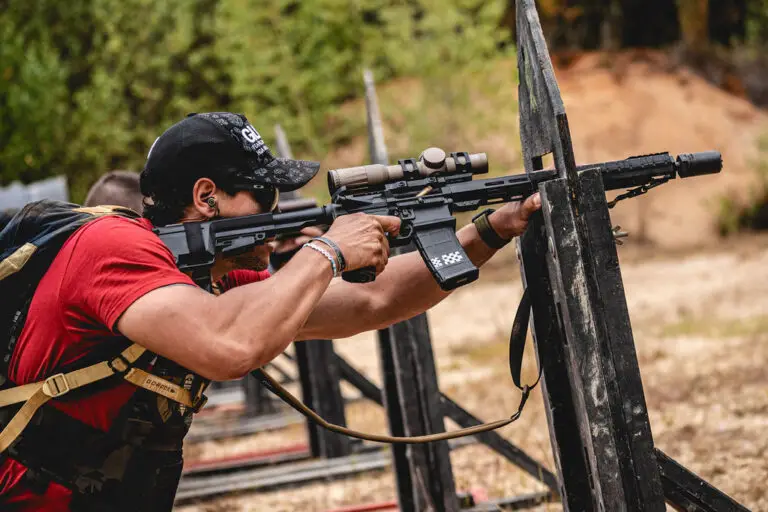
Mantis also makes the Blackbeard ($219) and BlackbeardX ($319) for AR-15 dry fire, an auto-resetting trigger system that lets you practice without racking the charging handle. The BlackbeardX integrates the Mantis X sensor for combined analytics. If you’re a 3-Gun or multigun competitor, the Blackbeard system is worth looking into separately, it solves a different problem than the X10 Elite.
How Does the Mantis X Compare to Other Training Tools?
The Mantis X is a diagnostic tool. It tells you what’s wrong with your trigger press and grip. But it’s not the only dry fire training option, and for competition shooters, it’s not necessarily the most impactful one.
Mantis X vs. LASR: I haven’t tested LASR personally, but based on its published capabilities, it measures draw times, transition times between targets, split times, and calculates hit factors, the core metrics that determine match placement. Mantis measures trigger press quality. They’re complementary, not competing.
For a competition shooter, LASR addresses the skills that matter most on the clock, transitions, draws, and target acquisition speed. Mantis fills the trigger diagnosis gap that LASR doesn’t address. If you can only buy one, ask yourself: do I need to fix what happens at trigger break, or do I need to get faster between targets? That answer determines which tool serves you better.
Mantis X vs. CoolFire Trainer: I haven’t used the CoolFire system, but it provides recoil simulation during dry fire using CO2, a different purpose entirely. It doesn’t diagnose anything; it just makes dry fire feel more like live fire. You can use both simultaneously if you want recoil simulation with trigger diagnostics.
Mantis X vs. a shot timer + snap caps: A $100 shot timer and a $15 snap cap let you train draws, reloads, transitions, and movement, four skills the Mantis can’t touch. You don’t get trigger press diagnosis, but you do get the skills that actually win matches. For a competition shooter on a budget, this combination delivers more match-relevant training value per dollar than the Mantis X alone.
Mantis Laser Academy (Pink Rhino cartridge): I use this alongside my X10 Elite. The Rhino laser cartridge fires when your striker hits it, not from a pressure switch, giving realistic trigger engagement. The Laser Academy app with smart targets tracks where your dry fire shots land, adding visual feedback that the Mantis sensor alone doesn’t provide. The X10 Elite tells you what your trigger press did; the laser tells you where it would have hit. Together they’re a stronger training stack than either alone.
For a deeper comparison of all available dry fire training systems, see our complete dry fire system roundup.
Mantis X10 Elite Specs
| Spec | Detail |
|---|---|
| Models | X2 ($99.99) / X3 ($169.99) / X10 Elite ($249.99) |
| Sensor Type | 9-axis IMU (gyroscope + accelerometer + magnetometer) |
| Mounting | Picatinny/Weaver rail (magazine baseplate adapter available) |
| Compatibility | Pistol, rifle, shotgun, bow (X10 Elite) |
| App | iOS and Android, free download |
| Battery | USB-C rechargeable, ~20 hours per charge |
| Guided Drills | 100+ in the app |
| Key Features (X10 Elite) | Shot analysis, recoil analysis, holster draw, cadence, multi-target, shooting on the move |
| MSRP | $249.99 (X10 Elite) |
Frequently Asked Questions
Is the Mantis X10 Elite worth it for USPSA?
For trigger control diagnosis, yes, it’ll show you anticipation and grip errors that cost points on close targets. But it can’t train transitions, reloads, movement, or stage planning, the skills that separate A-class from M-class in USPSA. Think of it as one tool in the toolbox, not the whole shop.
Which Mantis X model is best for competition shooters?
The X10 Elite ($249.99). The X3 lacks recoil analysis, holster draw tracking, and cadence data that matter for competition training. The X2 is dry fire only. If you’re buying for competition, the X10 Elite or nothing.
Does the Mantis X work for dry fire with snap caps?
Yes. Dry fire is where the Mantis X shines. The sensor detects the trigger press regardless of whether you’re using snap caps, a dry fire training device, or an empty chamber. The app’s guided dry fire drills are the strongest feature of the platform.
Can the Mantis X measure split times?
Not in the way a shot timer does. The X10 Elite tracks cadence, the time between shots, but this data doesn’t directly correlate to split times measured by a shot timer during live fire. For actual split time tracking, you need a dedicated shot timer.
Does the Mantis X work on AR-15s?
Yes, the X10 Elite mounts on any Picatinny rail. For AR-15-specific dry fire training, Mantis also makes the Blackbeard ($219) and BlackbeardX ($319), auto-resetting trigger systems that let you dry fire without racking the charging handle. The BlackbeardX integrates Mantis X sensor analytics.
Is the Mantis X accurate during live fire?
In my experience, the live fire readings don’t always match what I see on target. Shooting dot drills with my shots stacking on top of each other, the Mantis was reading all over the place. The sensor measures muzzle movement at trigger break, not bullet impact. For dry fire trigger diagnosis, the data is consistent and useful. For live fire, take the readings as one data point, not the complete picture.
What’s the difference between the Mantis X10 and X10 Elite?
As of 2026, the X10 and X10 Elite are effectively the same product, Mantis consolidated the lineup. The current X10 Elite ($249.99) is the full-featured model with all analytics capabilities including recoil analysis, holster draw, and multi-target drills.
Can I use the Mantis X with a holster?
Not easily. The sensor mounted on the accessory rail prevents holstering. Mantis offers a magazine baseplate adapter with a short pic rail and 3M tape, but in my testing the metrics were inconsistent, the magazine moves around in the magwell during draw and trigger manipulation, producing unreliable data. This is a real limitation for competition shooters working on draw-to-first-shot.