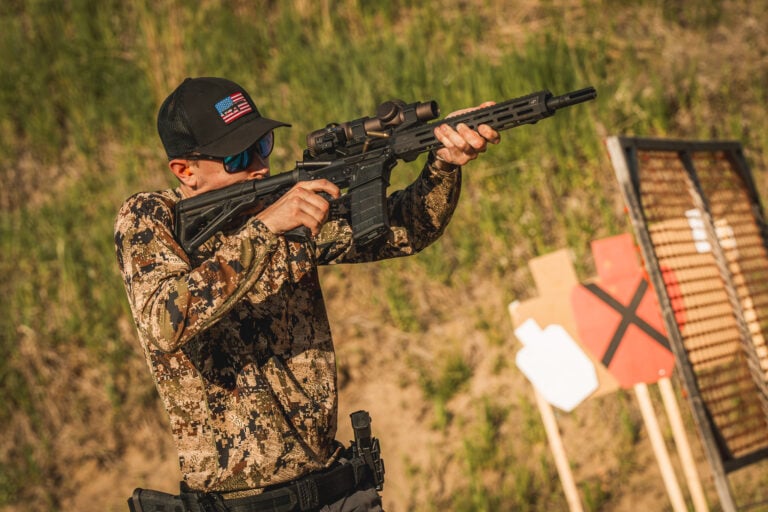
In 3-gun, your optic has to do two jobs: get on close targets fast at 1x and still hold up for the longer shots. The Vortex Venom 1-6×24 is a mid-priced LPVO for shooters who want that without paying top-tier money. Here’s how it held up for us on the clock.
Vortex Venom 1-6×24 Specs
| Spec | Detail |
|---|---|
| Magnification | 1-6x |
| Objective | 24 mm |
| Focal plane | Second (SFP) |
| Reticle | AR-BDC3, illuminated (BDC holds to ~650 yds) |
| Tube diameter | 30 mm |
| Eye relief | 3.7 in |
| Length | 10.3 in |
| Weight | 19.5 oz |
| Adjustment | 1/4 MOA per click, 25 MOA per rotation, 140 MOA total E/W |
| Turrets | Capped; throw lever included |
| Warranty | Vortex VIP unconditional lifetime |
| Price | ~$300 street (MSRP $450) |
First Impressions and Build Quality
Unboxing the Vortex Venom reveals a scope that feels robust but not overly hefty. Weighing in at 18.6 ounces, it strikes a balance between durability and portability, which is critical when every ounce counts in fast-paced competition scenarios. The 30mm tube is made from aircraft-grade aluminum, giving it the ruggedness you’d expect from Vortex while maintaining a sleek, streamlined profile.
The finish is a matte black anodization that resists scratches and glare—a small but appreciated detail for outdoor shooting in variable light conditions. One notable feature is its waterproof, fog-proof, and shockproof construction. While it’s unlikely you’ll be dunking your rifle in water mid-stage, the peace of mind during rainy competitions or high-humidity days is welcome.
Optical Clarity and Reticle Performance
Glass Quality
The glass clarity on the Venom is impressive for its price point. It features fully multi-coated lenses, which improve light transmission and reduce glare. In testing, the scope delivered a crisp, clear image from dawn through dusk, with minimal chromatic aberration. While the Venom’s optical performance won’t rival higher-end optics like the Razor HD Gen II, it punches above its weight in this category.
Reticle
The Venom uses Vortex’s AR-BDC3 reticle, specifically designed for AR platforms. It’s a second focal plane (SFP) reticle, meaning the size of the reticle remains constant regardless of magnification. This can be a pro or a con depending on your preference, but for 3-gun, it simplifies rapid target transitions at variable ranges without worrying about reticle scale.
The AR-BDC3 includes bullet-drop compensation (BDC) holdovers and windage corrections calibrated for standard .223/5.56 rounds. This reticle is illuminated, with 11 brightness settings. On bright days, the illumination may feel underwhelming at its highest setting, but the etched reticle remains visible regardless of ambient light.
For close-range work at 1x, the reticle’s simplicity shines, allowing for instinctive shooting akin to a red dot. At 6x, the BDC indicators provide a useful framework for precision shots up to 600 yards.
Verdict: A well-thought-out reticle and solid glass clarity make the Venom a reliable optic for 3-gun. However, it may fall short for competitors in bright, sunlit conditions.
Ease of Use in 3-Gun
The Vortex Venom’s design clearly considers the needs of competitive shooters. The true 1x magnification offers an eye-box that’s generous and forgiving. This makes acquiring targets fast, even in awkward shooting positions.
Switching between 1x and 6x is facilitated by an included throw lever. The lever is well-designed, with just the right amount of resistance to prevent accidental adjustments while remaining smooth to operate under stress. For stages requiring transitions between long-range precision and short-range speed, this feature is a godsend.
The Venom has a 3.5-inch eye relief, which is adequate for most AR setups. In practical terms, this means you won’t struggle to find a clean sight picture under the rapid movements of a 3-gun stage.
Field of View (FOV) at 1x is a respectable 116.5 feet at 100 yards, which aids target acquisition and transition during dynamic stages. At 6x, it narrows to 19.2 feet, which is fine but nothing special.
Verdict: The Venom’s usability in competition scenarios is one of its strongest suits. It’s intuitive, reliable, and fast, making it a compelling option for most 3-gunners.
Durability and Longevity
3-gun is hard on gear. Between rough transport, hard handling, and the occasional drop, an optic has to take abuse. The Venom’s build has held up to exactly that on our loaner rifle.
Vortex also backs the Venom with its VIP Lifetime Warranty, which is arguably one of the best in the industry. This warranty isn’t just marketing fluff; it’s an assurance that Vortex will repair or replace the scope should anything go wrong.
That said, the turrets—while functional—feel a bit less refined compared to higher-end optics. They offer tactile clicks, but the feedback lacks the precision you’d find in pricier alternatives.
Verdict: The Venom is built to last and comes with a warranty that eliminates long-term anxiety. However, the turrets could use an upgrade for more confidence while zeroing.
Price and Value
At an MSRP of $499 (and often found slightly lower online), the Venom is aimed at the mid-tier market. In comparison to higher-end options like the Razor HD Gen II-E or Nightforce NX8, the Venom gets you most of the way there at roughly a third of the cost.
For beginner to intermediate 3-gun competitors, this makes it an attractive proposition. The money saved can go toward ammunition, match fees, or other upgrades. However, serious competitors may eventually outgrow the Venom’s limitations, particularly its SFP reticle and lack of extreme low-light performance.
Bottom line: strong value for newer competitors or anyone on a budget. If you’re more advanced, you may want to save up for a higher-end optic.
How It’s Held Up: Notes From Our Loaner Rifle
We run the Venom 1-6 on one of the loaner rifles we bring to matches, so it gets handled by shooters who didn’t pay for it and aren’t precious with it. Across multiple matches and multiple shooters running it on the clock, it’s held zero and kept working: no fogging, no tracking drift, nothing rattling loose. At this price, holding up to that kind of shared-gun abuse says a lot.
The glass is clear for the money, and the AR-BDC3 reticle is quick to pick up. Eye relief is acceptable for an entry-level LPVO. It’s not the forgiving eye box you get on a Razor (more on that below), but you’re also paying a fraction of the price.
The AR-BDC3 Reticle
The AR-BDC3 is a second-focal-plane reticle, so the holdover hashes are true at 6x, not at 1x. The center has an illuminated aiming point for fast work up close, and the bullet-drop hashes run out to about 650 yards for 5.56. Because it’s SFP, think of 1x as your both-eyes-open, close-range setting and dial up to 6x when you’re actually using the holds at distance. The illumination helps the center pop in daylight, but it’s a usable daytime aiming point, not a true daylight-bright dot like a dedicated red dot.
Venom 1-6 vs Razor 1-10: Which One Do You Need?
We run both of these, so here’s how they actually stack up. The Razor HD Gen III 1-10 is a primary, do-everything competition optic: a really generous eye box, crisp glass, a first-focal-plane reticle, and 10x up top. It also costs several times what the Venom does.
The Venom 1-6 is where most people start. You give up the Razor’s eye box, the top-end magnification, and some glass quality. In return you get a durable, clear optic that’s quick to run and holds up on the clock, for a fraction of the price.
If you’re starting in 3-gun or PCSL and want a capable LPVO without spending Razor money, the Venom is a great choice. If it’s going to be your primary optic and you want the most eye box, glass, and reach you can get, step up to the Razor.
Who Should Buy It / Who Should Skip
Buy it if: you’re new to 3-gun, multigun, or PCSL and want a reliable first LPVO; you need a budget optic for a backup or loaner rifle; or you want a 1-6 that survives real match use without a top-tier price tag.
Skip it if: you want a top-tier eye box and glass, you need magnification past 6x, or you specifically want a first-focal-plane reticle for ranged holds. Those point you up to the Razor.
Frequently Asked Questions
Is the Vortex Venom 1-6 first or second focal plane? Second focal plane (SFP). The reticle holds are true at 6x.
Is the Venom 1-6 good for 3-gun? Yes, as an entry-level option. It’s clear, durable, quick on 1x, and it holds zero through hard use. Spending more mostly buys you a better eye box and more magnification.
Does it have a daylight-bright reticle? It has an illuminated center that’s usable in daylight, but it’s not as bright as a dedicated red dot.
What’s the warranty? Vortex’s VIP unconditional lifetime warranty.
Comparing options? See our Best LPVO for 3-Gun guide for how these stack up against each other.