Checked against the PCSL General Rulebook, version 2026-05-05.
PCSL Practical division is where I shoot 2-Gun, and it’s where I tell every new PCSL shooter to start. My rifle and pistol for the Tactical Games are legal in it with no changes, and the gear that passes Practical rules usually passes whatever else I’m shooting that month.
The catch is that Practical has a handful of specific rules that a normal-looking AR can break without you noticing: a brake on the muzzle, a lightweight bolt carrier, a coupled mag. Break one and you’re shooting Competition for the rest of the match.
This page is the cheat sheet I’d hand a squadmate, then the detail behind each rule, then a quick way to check your gear before match day. For how PCSL works overall, start with our complete guide to PCSL 2-Gun.
PCSL Practical Division Cheat Sheet
| Rule | Handgun | Rifle |
|---|---|---|
| Calibers | 9x19mm to .45 ACP | 5.45×39 or 5.56×45 up to .308 Win. No PCC |
| Power factor | 125 minimum; 1,600 fps max | None |
| Rounds in magazines at the start signal | 20 | 30 (bigger mags and drums OK if loaded to 30) |
| Muzzle | No compensators, no porting | No muzzle brakes, except to mount a suppressor that stays attached |
| Optics | No frame-mounted optics (slide-mounted dots and irons are fine) | No restrictions |
| Internals and add-ons | Gas pedals, lights, lasers, magwells allowed | BCG at least 10.8 oz (AR-15); magwell 2.000″ max; no coupled mags |
| Support gear | n/a | No bipods, bags, or tripods |
| Suppressors | Not listed | Allowed |
Everything else, including holster rules, magazine carry, and safety, is the same for both divisions. That’s covered further down.
What Is PCSL Practical Division?
PCSL Practical is the restricted core division in PCSL 2-Gun. The rifle must be a rifle caliber (5.45×39 or 5.56 up to .308) with no muzzle brake, a full-weight bolt carrier, and 30 rounds or fewer per magazine. The handgun is 9mm to .45 ACP at power factor 125, with no comp and no frame-mounted optic, loaded to 20.
In PCSL 2-Gun, your division is the pair: a Practical rifle plus a Practical handgun. If either gun breaks a Practical rule, you’re in Competition.
Practical Handgun Rules
Caliber and power factor. 9mm through .45 ACP, making 125 power factor or better, with bullets under 1,600 fps. Power factor is bullet weight in grains times velocity in fps, divided by 1,000. A 124-grain 9mm needs about 1,010 fps to make 125. Chrono is up to the match director. If a match runs one and you come in light, you’re moved to the next division with no power factor requirement, which in 2-Gun is Competition.
20 rounds in the magazine at the start. The limit is on rounds loaded in magazines when the buzzer goes, and it applies to every magazine you use. Every extra round in a magazine you use on the stage is a procedural. Magazine length isn’t limited, so a big-stick magazine is legal as long as it holds 20 or fewer when you start.
My 2-Gun pistol is an OA Defense 2311 Pro Elite. I run Magpul 21-round AMAGs and load every one to 20. One round short, every time, so I never have to think about it at the loading table. Before the 2311 I ran a Staccato P for several seasons.
No comps, no porting. This is the rule that knocks most race guns out. A ported slide, ported barrel, or a comp puts you in Competition. My 2311 came with a ported barrel from the factory. I swapped it for the non-ported barrel, which OA now offers as an option when you buy the gun, and it runs no comp. That one change is what makes it Practical-legal.
No frame-mounted optics. A red dot on the slide is fine. So are irons. I shot the Staccato P with irons in Practical for several seasons, and nothing in the division requires a dot. My 2311 runs a Vortex Defender-XL on the slide.
Allowed: gas pedals, lights and lasers, and magwells, with no size limits listed for Practical.
Practical Rifle Rules
Caliber. Rifle calibers from 5.45×39 or 5.56 up to .308 Win. No pistol caliber carbines: if you want to run a PCC, that’s Competition (or a Pistol Caliber 2-Gun match). If you swap uppers between stages, you can only swap within the same caliber class unless the match director allows otherwise.
30 rounds at the start signal, no coupled mags. A 40-round PMAG is legal if it’s loaded to 30. Drums too. Two magazines clamped side by side are not.
Muzzle brakes are out. This is where most Practical rifles get into trouble, so here’s exactly how PCSL draws the line:
- A muzzle brake, per the PCSL glossary, has externally visible braking baffles and exists for one purpose: cutting recoil. Those are prohibited.
- A compensator or hybrid device that also does other jobs (the rulebook uses the PWS FSC as its example) isn’t classified as a brake. Those are legal.
- A brake used only to adapt a suppressor, with the suppressor attached, is legal.
- A blast shield (Warden or Griffin Blast Shield type) on a brake is legal, as long as it sends all the gas forward.
- As of February 2026, a brake on the end of a suppressor is no longer allowed.
If you’re not sure which side of that line your device sits on, ask the match director before the match, not at the first stage. Our roundup of AR-15 comps covers devices by design; check each against the glossary definition before you run it in Practical.
My JP-15 runs a JP 3-prong flash hider pinned to a 13.5″ barrel, so this one’s easy for me.
Bolt carrier group: 10.8 ounces minimum. Practical bans lightened and reduced-mass BCGs. The assembled BCG can’t weigh more than 0.2 oz under the platform’s OEM mass, and PCSL sets the AR-15 OEM at 11.0 oz. So 10.8 oz is the floor.
I run full-mass carriers now across most of my rifles, including the JP-15, which settles it. If you run a low-mass carrier to tune recoil, weigh it before you register (how-to below).
Magwell up to 2.000 inches wide. Measured at the outer width.
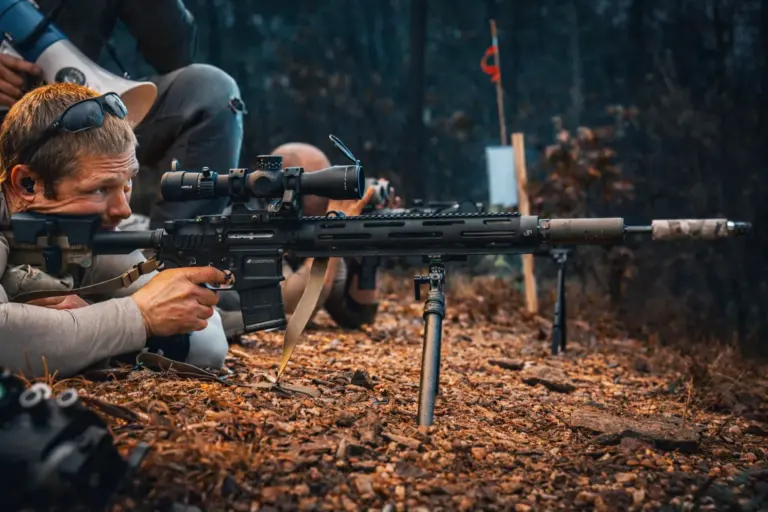
No bipods, bags, or tripods. Brace on walls, barricades, and props inside the shooting area instead.
Optics are unrestricted, and suppressors are allowed. LPVO, red dot, offset dot, all of it. My rifle wears a Vortex Razor 1-10 with a red dot on a 45-degree offset. For optic picks, see the LPVOs we’ve run on the clock.
Rules That Apply to Every Division
These aren’t Practical rules, but they’re the ones new shooters ask me about most:
- Holster. Secured to a waist-level belt and completely covering the trigger guard. It sits between 12 and 4 o’clock (12 and 8 for lefties), with the muzzle pointing within 3 feet of your feet when you stand relaxed. No retention requirement.
- Magazines. Pouches aren’t required, but spare mags have to start on your body and not in your hands. Nothing can hold a spare mag on the gun itself.
- Dropped guns. Loaded is a Match DQ. Unloaded is a Stage DQ.
- Prone with a holstered pistol. Only if the pistol is verified unloaded (Drop-Mag Target procedure, or started unloaded and never loaded). Otherwise, Stage DQ.
- Wrong gun on a target. Misses plus a Failure to Engage.
My take on holster retention: This is my preference. The rulebook doesn’t require it. I run a G-Code XSR Level 2 Duty holster for every pistol I compete with. Flipping the hood on the draw is a small manipulation. A loaded pistol falling out mid-stage while I’m running the rifle is a Match DQ. I’ll take the extra motion.
For the full belt build, see how to set up a competition belt for any discipline. Mine is a G-Code Assaulter belt with the XSR and G-Code Tall Scorpion pouches for pistol mags.
How to Check Your Gear for Practical (Before Match Day)
Ten minutes at the bench saves a division bump at the match.
1. Identify your muzzle device. Find the maker and model. If it’s sold as a brake with open side baffles and no other stated purpose, it’s a brake. If you can’t tell, email the match director a photo. Common mistake: assuming “it came on the rifle” means it’s a flash hider.
2. Weigh the bolt carrier group. Pull the BCG and weigh it assembled: carrier, gas key, bolt, cam pin, firing pin, and retaining pin. A kitchen scale that reads to the gram works. You need 10.8 oz, or about 306 grams. Common mistake: weighing the carrier alone and calling it light. The rule is the assembled BCG.
3. Count your magazines. Load rifle mags to 30 and pistol mags to 20. If your pistol mags hold more, load them to 20 every time so you never have to think about it. Common mistake: topping off a pistol mag between stages out of habit.
4. Look at the pistol’s slide and barrel. Any ports or a comp mean Competition. Any optic mounted to the frame means Competition.
5. Check power factor if you reload. Chrono your load and confirm it clears 125 with margin. If you shoot factory ammo, remember the velocity on the box comes from the maker’s test barrel, not your pistol, so chrono it too if you’re close.
6. Check your holster. Covers the trigger guard, sits between 12 and 4 o’clock, muzzle within 3 feet of your feet.
Common Ways Shooters Get Bumped to Competition
In PCSL, if any gun or piece of gear you use on a stage stops meeting your division’s rules, you’re moved to Competition. Here’s what does it, with the rule each one breaks:
- A muzzle brake on the rifle. Common on rifles built for 3-Gun. (B.1.2)
- A lightweight or low-mass BCG. Common on rifles tuned for flat recoil. (B.1.2)
- A ported or comped pistol. Many race 2011s and some factory “competition” models. (A.1.2)
- A frame-mounted optic on the pistol. (A.1.2)
- A PCC as the rifle. (B.1.2)
- Coupled rifle magazines. (B.1.2)
- Failing power factor at chrono. (4.5.3)
- A bipod on the rifle. Not legal in either 2-Gun division. (B.1.1, B.1.2)
Loading a magazine over the limit won’t move your division, but it costs one procedural (10 points) per extra round. (12.8)
Will My USPSA, 3-Gun, or Tactical Games Gear Work in Practical?
USPSA Carry Optics pistol: almost always, once you load it to 20. CO already bans comps and frame-mounted dots. Check your holster against the PCSL position rule; most CO holsters pass.
3-Gun Tactical or Limited rifle: usually, but check the muzzle and the carrier. Many 3-Gun rifles run brakes.
Tactical Games rifle: this is my case, and it’s the easiest crossover. TTG doesn’t allow compensators, only flash hiders or suppressors, so a TTG rifle already passes the Practical muzzle rule. Suppressors are legal in both; I don’t run one, just personal preference. Weigh the BCG and you’re done.
Tactical Games pistol: usually legal. Check the round count in your mags.
Practical vs Competition: Which Should You Shoot?
Shoot Practical if your gear already fits it. You’ll be scored against people running the same kind of equipment, and you won’t have to maintain a second setup. That’s the reason I shoot it.
Shoot Competition if your gear doesn’t fit Practical and you don’t want to change it, or if you want to run a PCC, a race pistol, or a braked rifle. It’s the open lane, with a few limits of its own. Our PCSL Competition division guide has the full cheat sheet.
Don’t buy new gear to move between divisions before your first match. Shoot what you have, in whichever division it fits.
FAQ: PCSL Practical Division
Can I use a compensator in PCSL Practical?
On the rifle, it depends on the device. PCSL bans muzzle brakes, defined as devices with visible braking baffles made purely to reduce recoil. Hybrid comps that also handle muzzle rise or flash aren’t brakes. On the pistol, no: compensators and porting are prohibited in Practical.
How heavy does my BCG need to be for PCSL Practical?
At least 10.8 ounces assembled on an AR-15. The rule allows the BCG to be no more than 0.2 ounces under the platform’s OEM weight, and PCSL uses 11.0 ounces as the AR-15 OEM figure. Weigh the full assembly: carrier, gas key, bolt, cam pin, firing pin, and retaining pin.
Can I run a red dot on my pistol in PCSL Practical?
Yes, if it’s mounted on the slide. Practical bans frame-mounted optics only. Iron sights are also legal, and competitive; I shot a Staccato P with irons in Practical for several seasons.
Can I use a PCC in PCSL Practical?
Not at a standard PCSL 2-Gun match. Practical requires a rifle caliber, 5.45×39 or 5.56 up to .308. A PCC puts you in Competition. PCSL also runs a separate Pistol Caliber 2-Gun match type where everyone shoots a PCC and division is set by the handgun.
What happens if my gear isn’t legal for Practical?
You’re moved to Competition division. If your gear isn’t legal in any division offered at the match, your scores are removed. Over-loaded magazines don’t change your division, but each extra round in a magazine you used costs a 10-point procedural.
Are bipods allowed in PCSL Practical?
No. Bipods, bags, tripods, and other support devices are prohibited in Practical. They’re also prohibited in Competition at 2-Gun matches. Only PCSL Rifle and 3-Gun matches allow them, in Competition division.