500 Yards Isn’t Long Range Anymore
In Parts 1 through 3, I covered the gear: the JP MR-19 chambered in 6mm Creedmoor, the Vortex Razor and Strike Eagle optics, the tripod, spotting scope, and all the support equipment. That was the shopping list. This is where I actually had to use it.
I drove down to Blue Steel Ranch in Logan, New Mexico, for back-to-back PR1 and PR2 courses. Six straight days of shooting and classroom instruction under Brian Whalen, the lead instructor at BSR. Brian is a retired U.S. Army Special Forces operator who graduated from SOTIC (Special Operations Target Interdiction Course), taught long-range instruction across four continents, and co-designed the APAC chassis that my MR-19 rides in. His background in precision rifle instruction and competition speaks for itself.
What I will tell you is this: those six days were the most fun I have had shooting in years. And also the most humbling.
In 3-gun, my buddies and I would go to the range and shoot at what we called “long range.” That meant 500 yards. At Blue Steel Ranch, we were taking shots out to 1,350 yards, and the range had targets set out to 1,600. I was 50 yards from my cabin taking those shots. The scale of what “long range” actually means hit me on day one and never let up.
PR1: Starting From Zero (Literally)
Day One: The Classroom
I will not sugarcoat it: day one of PR1 was rough for me.
I showed up ready to shoot. Instead, I spent most of the day in a classroom taking notes, listening to Brian teach from a whiteboard, and learning things I did not know I did not know. Ballistic fundamentals, data gathering, how to set up and use a Kestrel, which I had never touched before this class.
I am a guy who likes to move. I drink coffee, I want to be doing something with my hands, and if guns are involved, I want to be behind one pulling a trigger. Sitting in a classroom absorbing information about ballistic coefficients and atmospheric inputs was not my natural state. But the information mattered. Everything we covered that day was foundation work that the rest of the week built on.
The Kestrel alone was a learning curve. I had to input all the data for my rifle and ammunition: bullet weight, ballistic coefficient, muzzle velocity, all the environmental variables. Before I could shoot, I needed my Kestrel to know what my rifle was doing so it could feed me accurate firing solutions. Brian has loaner Kestrels available for students who don’t own one, which is a nice touch for people testing the waters.
By the end of the day, we finally moved to the zero bay. I was thinking: finally, I get to lay prone, get behind my rifle, and start putting rounds on steel.
That is not what happened.
Getting Set Up as the Guinea Pig
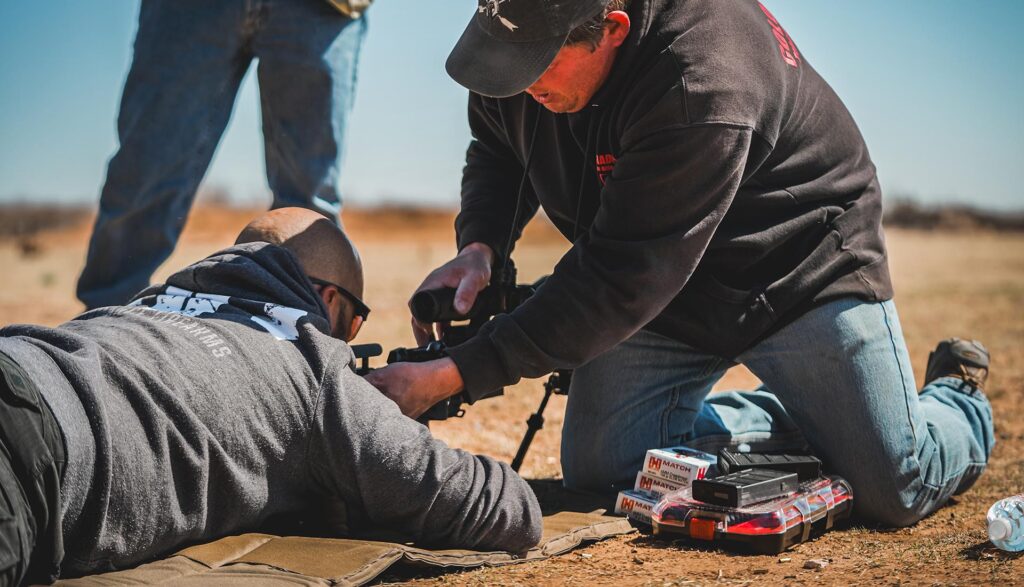
Brian used me as a demonstration for the class. I got behind my MR-19 in a prone position, and within minutes he identified that the rifle was not set up properly for my body and shooting style.
We adjusted my cheek weld. We moved my butt pad higher, so it now sits more even with the bolt, which Brian has a specific methodology behind. We changed my eye relief. And then, just when I thought we were ready to shoot, Brian said we needed to set my parallax.
Here is something I am slightly embarrassed to admit: I have been in the firearms industry for years, I have shot competitively since 2012, and I did not fully understand parallax adjustment before this class. I knew what it was in theory. I did not know that improper parallax could be the reason you are missing targets at 800 or 900 yards while thinking it is a wind problem or an elevation issue.
You have to set your parallax before you zero. If you zero with incorrect parallax, you are building your entire data set on a flawed foundation. Misses at distance that look like wind or DOPE errors could actually be parallax errors that you baked in from the start.
That moment, standing at the zero bay feeling like a beginner despite years of competition experience, is exactly why you take classes. I don’t care how long you have been shooting. If you have not had formal precision rifle instruction, there are gaps in your knowledge. I found mine on day one.
Day Two: Known Distance and Data Truing
After a morning classroom refresher, we moved to the known distance range. This is a range with targets set at precise intervals: 400, 500, 600 yards, and so on out to 1,600. The purpose is to verify that your ballistic data actually matches what your rifle does in the real world.
We started at 500 yards, confirmed hits, and then dialed out to 1,000. At 1,000 yards, there is a trueing bar, a 6-foot-long piece of steel that is only 4 inches tall. You are not worrying about wind here. All you are trying to do is get on that 4-inch bar to verify your elevation data.
If you are a little high or low, you take a few shots, then go into your ballistic calculator and adjust. Brian had us modify the ballistic coefficient (BC) of our bullet rather than changing muzzle velocity. Some shooters true by adjusting velocity, but Brian’s methodology uses BC, and after researching it on my own since the class, I have stuck with that approach. The reasoning gets into the weeds, but the short version is that BC changes affect your trajectory curve differently than velocity changes, and adjusting BC tends to true more consistently across multiple distances.
I partnered up with a student named Cody, and we spent the rest of the day shooting known distance together, one behind the rifle, one behind the spotting scope, calling shots and working through our data. By the end of day two, I felt confident. My data was truing up, I was connecting at distance, and I ended on a high note.
Day Three: The Rim
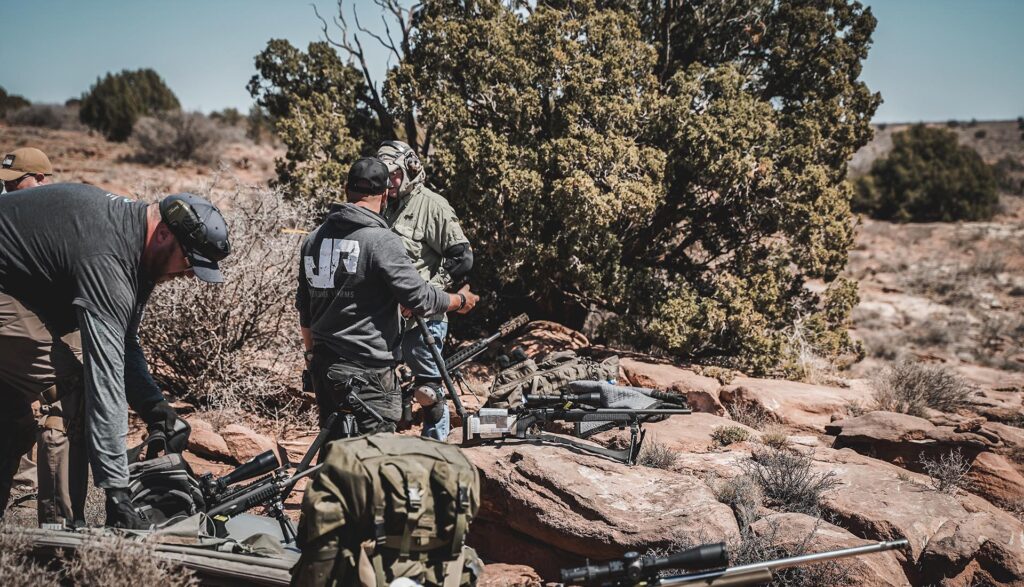
Day three started with a cold bore shot out to 1,000 yards. No warm-up, no sighters. You build your position, check your data, read the wind, and send it. That is how matches work. You don’t get practice shots on your first stage.
After some wind call work, Brian took us out to what everyone at BSR calls the rim. If you have never been to Blue Steel Ranch, the rim is this canyon with targets scattered on stands at various distances and angles. Nothing is painted. Nothing is obvious. You get on your glass, start searching, and when you find a target, you range it, read the wind, and shoot.
Every time you move 25 yards along the rim, a whole new set of targets opens up. The wind behaves differently depending on where you are standing and which direction you are shooting. It is the closest thing to a match environment you can get in a training setting.
This is where everything from days one and two came together. The Kestrel data, the trueing process, the wind reading fundamentals: all of it had to work in concert on targets I had never seen before at distances I had to range myself. I was working with Cody, alternating between shooter and spotter, using the reticle eyepiece on my spotting scope to call his shots and give corrections.
By the end of day three, I was exhausted. Not physically tired like after a Tactical Games event. Information overload. My brain was full.
PR2: Picking Up the Pace
Most BSR classes schedule PR1 and PR2 a couple weeks apart. This session ran them back to back: PR1 was Wednesday through Friday, PR2 was Saturday through Monday. Six consecutive days.
Some PR1 students left Friday night and a new group of PR2 students arrived, all of whom had already completed PR1 previously. Cody decided to stay and sign up for PR2 on the spot, which meant I had a familiar partner going into the second course. We cooked dinner at the bunkhouse, met the new students, and talked about what was coming.
Day Four (PR2 Day One): Timer Pressure
Brian spent a quick session in the classroom making sure everyone’s Kestrel data was current, got the new students set up on loaner Kestrels if needed, and then we were on the known distance range within two hours.
The difference from PR1 was immediate: Brian put us on the clock.
He would call your name and say “shoot.” You had to read the wind, make your call, and break the shot. Then he would call the next shooter’s name. You could not predict when your turn was coming, so you had to stay ready: wind call current, data dialed, position built.
Cold bore shots out to 800 and 900 yards on a timer. That is a step up from the deliberate, self-paced shooting in PR1. It is also a much better simulation of what happens at an actual match, where the clock is running and you don’t get to wait for conditions you like.
We shot most of the day. There was some rain, which added another variable but did not stop anything. The day went fast.
Day Five (PR2 Day Two): The .22 LR Revelation
After a morning on the known distance range, Brian brought us back to the zero bay around midday. I remember thinking: I am already zeroed. Why are we here?
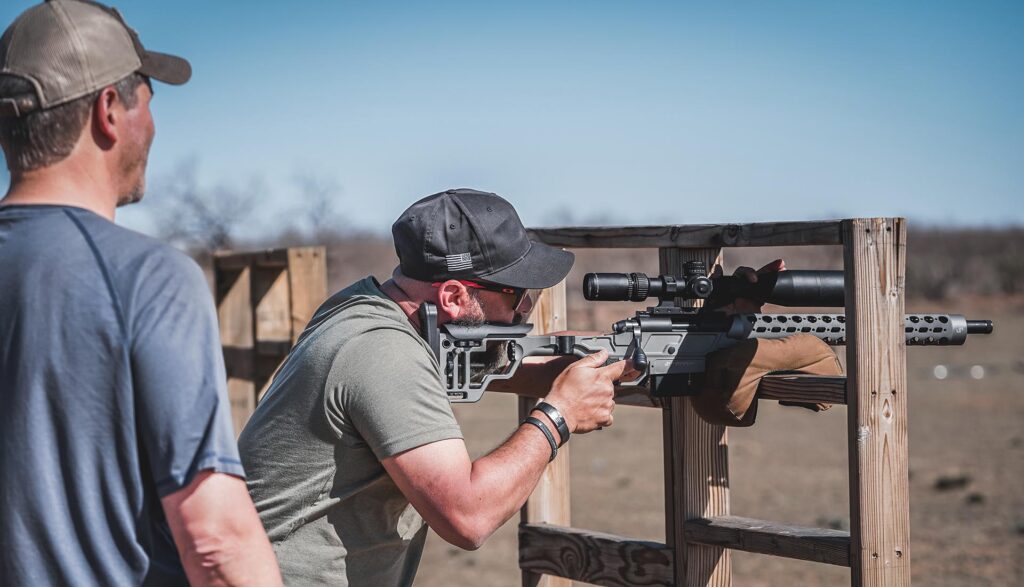
Then Brian started pulling out .22 LR rifles. Vudoo Gun Works actions, Rugers, Savages, a few CZs. Moving targets. “Know your limits” targets. Barricades everywhere.
This was the highlight of my entire six days at BSR.
The whole point of the .22 session was positional shooting. Brian wanted us on barricades, using bags, building positions that were stable enough to make precise hits from awkward angles. Not the positions that felt comfortable, the positions that were actually correct.
That is a distinction worth explaining. When you are new to barricade shooting, you naturally settle into whatever feels least awkward in your body. But the position that feels comfortable and the position that actually removes shooter error are often different things. Some of the best shooting positions feel a little weird. You might look goofy. But if the rifle is stable and your natural point of aim is on target, that is the position you want.
I shot somewhere around 500 to 600 rounds of .22 that day from barricades, barrels, prone, and on movers. The volume was only possible because the ammo cost next to nothing compared to 6mm Creedmoor. And the skills transferred directly: building stable positions, using bags correctly, finding natural point of aim on barricades, managing the rifle through recoil (even .22 recoil matters when you are working precision targets).
By the end of the day, we were running informal competitions: fastest barricade runs, keeping all the spinner plates down at once with the whole class shooting simultaneously. It felt like being a kid again, plinking with a .22 on a Saturday afternoon. Except now I was building skills that would directly help me at my first real match.
That day cemented something I had been thinking about since Part 1 of this series: a .22 trainer rifle is not a compromise. It is a legitimate training tool. The JP Apparition sitting in my APAC chassis at home just moved up my priority list.
Day Six (PR2 Day Three): Back on the Rim With Tripods
The final day put us back on the rim, but this time Brian incorporated tripod shooting. He would assign a sector (“your targets are from point A to point B”), give us a time limit, and let us work with our partners to find targets, range them, and engage.
This combined everything from the week: the ballistic data we had built and trued, the wind reading fundamentals, the positional shooting from the .22 day, the spotting scope work, and now the tripod. Find the target, build the position, read the wind, communicate with your partner, make the shot. All under time pressure.
Six days. And I walked away from Blue Steel Ranch understanding precision rifle in a way that no amount of YouTube videos or forum posts could have given me.
What Actually Stuck
I want to be specific about what I took away from BSR, because “it was a great class” does not help you decide whether to attend.
The Kestrel is not optional. I went in never having used one. I left unable to imagine shooting a match without it. The ability to get a firing solution that accounts for real-time atmospheric conditions, your specific load data, and your trued ballistic profile: that is the difference between guessing and knowing.
Parallax matters more than I thought. Setting parallax correctly before zeroing is foundational. If you skip it, you are introducing an error that looks like other problems at distance. This was the single most embarrassing knowledge gap I closed at BSR.
Truing your data is a process, not a one-time event. You zero, you shoot at known distance, you adjust your BC, you verify. The data set you leave the range with should be different from the one you arrived with, because now it reflects what your rifle actually does instead of what the manufacturer’s box says it should do.
Comfort and correctness are not the same thing in positional shooting. The position that feels natural is often not the one that produces the best results. Building positions with bags on barricades is a skill that requires reps, and .22 LR is the cheapest way to get those reps.
Everything connects. The classroom work that frustrated me on day one was the reason I could speak the same language as experienced competitors at my first match. When someone said they were dialing 6.5 and holding .4 mils, I knew exactly what that meant. That would not have been the case without the BSR foundation.
BSR: The Practical Details
If you are considering attending, here is what you need to know. Blue Steel Ranch is in Logan, New Mexico, owned and operated by JP Enterprises with Brian Whalen as lead instructor. They offer PR1, PR2, and PR3 courses. Classes are also scheduled through Colorado Precision Rifle.
You stay on site. There is a bunkhouse that sleeps 12 to 14 people with two restrooms and a full kitchen. Bring your own food, cook on site. You don’t need to leave BSR for the duration of the course. That setup means you are eating dinner with your classmates, talking about what you learned that day, and building relationships with other shooters who are on the same path.
Round count varies by shooter. Some guys in my PR1 class shot 700 rounds. I shot about 350 in PR1 and another 350 in PR2. The difference was how I chose to spend my time. I was behind the spotting scope and picking Brian’s brain as much as I was behind the trigger. Both approaches have value. If you are there to build volume, the range time is available. If you are there to absorb as much knowledge as possible, the instruction supports that too.
The friendships I built at BSR were stronger than anything I have taken away from major 3-gun matches. Six days of living, eating, and training together creates a different bond than shooting the same match and going home. Multiple people from my class have become regular contacts in my precision rifle network.
What’s Coming Next
In Part 5, the final installment, I am heading back to Blue Steel Ranch, but this time it is not a class. I am shooting the Competition Dynamics Team Safari with Dave Castro. It is a team match with a hike-in component. We find our targets, range them, and engage, all under a time limit of about six minutes per position.
This is the first real test of everything I have learned. The rifle, the optics, the support gear, the BSR training, all of it. My first actual precision rifle competition.
Stay tuned.
What is Blue Steel Ranch?
Blue Steel Ranch (BSR) is a precision rifle training facility in Logan, New Mexico, owned and operated by JP Enterprises. It features a known distance range with targets from 400 to 1,600 yards, a zero bay, and a natural terrain range called “the rim” with targets at various distances and angles across a canyon. BSR offers PR1, PR2, and PR3 courses and provides on-site lodging in a bunkhouse with a full kitchen, so students don’t need to leave the property during the course.
What is PR1 vs PR2 at Blue Steel Ranch?
PR1 (Precision Rifle 1) is the foundational course covering ballistic fundamentals, Kestrel setup, data gathering, zeroing methodology, parallax adjustment, data truing on known distance, and introductory field shooting on the rim. PR2 builds on PR1 with more time pressure, timed shooting drills, advanced positional shooting with .22 LR on barricades, and extended field sessions with tripods. PR1 is a prerequisite for PR2. Each course runs three days.
What is data truing in precision rifle?
Data truing is the process of verifying and correcting your ballistic calculator’s predictions against actual impacts at known distances. You shoot at a trueing bar (a long, narrow steel target) at a set distance like 1,000 yards, compare where your rounds actually land versus where your calculator predicted, and then adjust the ballistic coefficient (BC) in your calculator until the data matches reality. This creates a firing solution based on what your rifle actually does rather than theoretical calculations.
Do I need a Kestrel for precision rifle competition?
A Kestrel weather meter with a ballistic solver is a core tool for precision rifle competition. It measures real-time atmospheric conditions (temperature, pressure, humidity, wind) and combines that data with your rifle and load information to calculate firing solutions. Most serious competitors run one. BSR provides loaner Kestrels for students who don’t own one yet, and many training facilities do the same.
How many rounds should I bring to a precision rifle class?
Round count varies by shooter and class format. At BSR’s PR1, some students shot 700 rounds while others shot 350 in the same course. It depends on how you balance trigger time with observation and instruction. A safe estimate is 400 to 500 rounds of centerfire ammunition for a three-day course, plus whatever .22 LR the facility provides or requests for positional shooting sessions. Check with the training facility for specific recommendations before attending.
Why use .22 LR for precision rifle training?
Shooting .22 LR on barricades and positional stages builds the same skills as centerfire: stable position construction, natural point of aim, bag usage, and trigger control, at a fraction of the ammo cost. A day of heavy .22 training (500+ rounds) costs what a few dozen rounds of 6mm Creedmoor would. The lower recoil also lets you focus purely on position and fundamentals without managing a harder-kicking rifle. Most precision rifle training facilities incorporate .22 LR positional work for these reasons.