
The Complete Guide to Getting Started and Training for The Tactical Games
If you’ve ever wondered what it feels like to push your body to its breaking point while trying to place precision shots on target, The Tactical Games might be exactly what you’re looking for. This isn’t your typical shooting competition where you run through a stage and smash the trigger. This is where fitness meets marksmanship in the most demanding way possible.
Whether you’re coming from CrossFit wondering about the shooting side, or you’re a seasoned shooter curious about adding some serious physical punishment to your game, this guide walks you through everything you need to know. By the end, you’ll understand exactly what The Tactical Games is, how to find your first event, what gear you need, how to train for it, and what to expect when you step up to that start line with your heart already pounding.
What Are The Tactical Games?
The Tactical Games is a competitive sport that combines functional fitness with precision marksmanship under stress. Athletes complete physical challenges—think sled drags, sandbag carries, rope climbs, and shuttle runs—followed by shooting sequences with rifle and pistol. Scoring is primarily time-based with penalties for missed shots, testing both physical output and shooting fundamentals in a single continuous effort.
The format is built to test how well you shoot after you’ve been smoked by a workout. You don’t just stand and deliver here. You run, carry, lift, sweat, and shoot all in one continuous grind until you’ve completed the prescribed work or hit the time cap.
What makes The Tactical Games different from other shooting sports is the emphasis on practical fitness under measurable shooting standards. You can’t win without being a good marksman, and you can’t win without being fit. There’s no way to outdo one or the other—the format is designed to punish weaknesses in either domain without mercy.
How Is The Tactical Games Different From Traditional Shooting Sports?
In USPSA or 3-Gun, your heart rate might spike from the adrenaline of the timer, but you’re not genuinely exhausted when you draw your pistol. In The Tactical Games, you’ve just dragged a 200-pound sled 50 feet, completed 10 sandbag cleans, and now you have to place accurate rifle shots at distance while your lungs are on fire and your hands are shaking.
This isn’t a tactical simulation, and it doesn’t mimic real-world engagements. While the sport may have started with that in mind, the modern format is strictly focused on testing physical capability and shooting skill through well-defined, repeatable challenges. It certainly provides the stimulus for high-stress engagements, but it’s a sport first.
The shooting standards emphasize bullseye-style marksmanship fundamentals rather than the speed-focused action shooting you’d see at a USPSA match. The published 2025 shooting standards set a baseline pace of roughly 4 seconds per rifle round and 3 seconds per pistol shot. That might sound slow until you’re trying to hold steady after a 90-second max-effort interval.
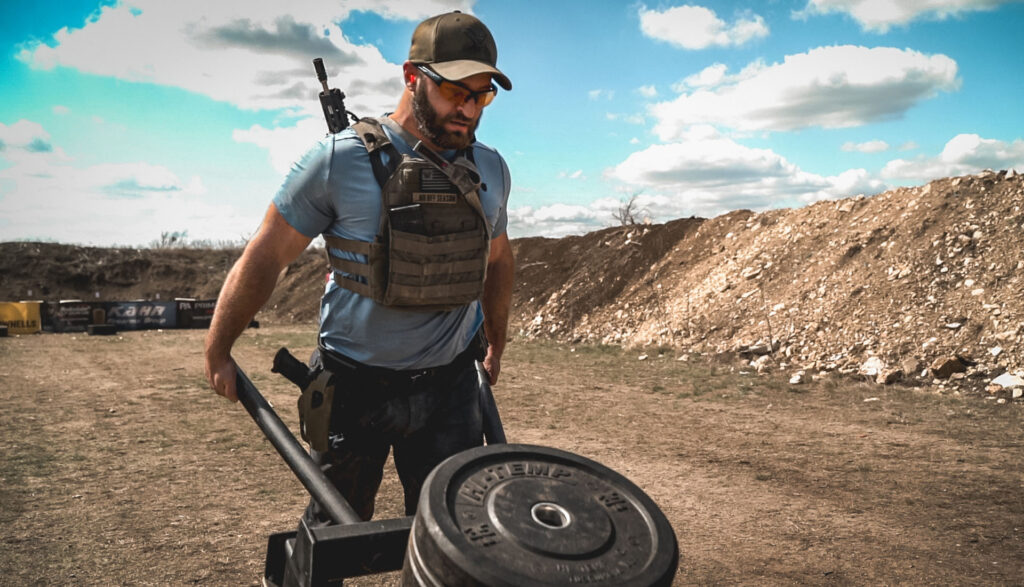
What Does a Typical Regional Event Look Like?
Regional events run Saturday and Sunday, with eight stages total—four each day. National Championships extend to three days (Friday through Sunday) with additional stages. Here’s how those eight stages typically break down:
- Four standard Tactical Games stages: These are your work-shoot-work-shoot grinders. You’ll alternate between fitness tasks and shooting sequences for a total number of prescribed rounds. These stages run 8-12 minutes and test your ability to maintain marksmanship while under physical duress.
- Two shooting-only stages: One is typically a published shooting standard (50 points) that you can practice at home. The other is an action stage—a 2-Gun style course of fire with steel targets, movers, and positional shooting. These stages create the biggest potential point gaps between competitors.
- Two fitness-only stages: One is a long movement—a timed run in full kit (plate carrier, belt, rifle, pistol) ranging from 1.5 to 4+ miles depending on the venue. The other is a published fitness standard (50 points) lasting around 90 seconds.
Stages are scored either time-based (fastest athlete after penalties earns 100% of points) or performance-based (top performer in reps or accuracy earns 100%). Standard stages are worth 100 points; published standards are worth 50 points. Consistent performance across all formats matters more than dominating just one type.
Finding Your First Event: Where Should You Start?
The best place to find official events is The Tactical Games website, which hosts the full schedule of regional events across the country. These are two-day sanctioned competitions where scores count toward qualification for the National Championship at the end of the season.
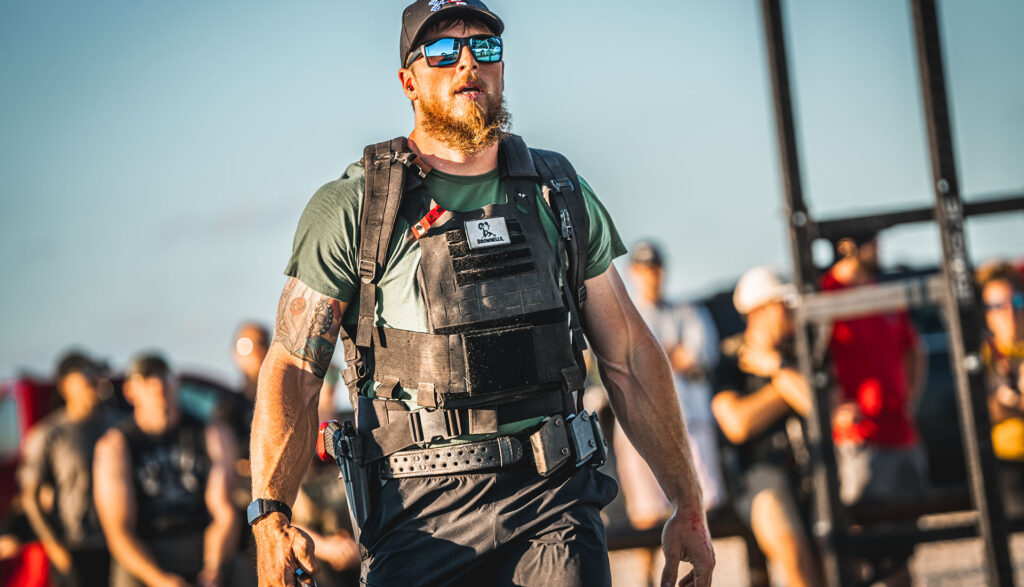
The Tactical Games Skirmishes
Skirmishes are single-day, local events run by Tactical Games affiliates. They follow the same format as regional events—combining grueling workouts with tough shooting stages—but in a more accessible package. Lower entry fees, no multi-day travel commitment, and a generally more relaxed environment make them an ideal entry point for new competitors.
Skirmishes are rapidly growing in popularity, and for good reason. You get the full Tactical Games experience without the logistical complexity of a weekend event. Seasoned competitors also use them as training grounds to sharpen specific skills between regional events.
How Can You Prepare Before Your First Event?
The TTG Complete Training Program is worth considering. It’s a subscription-based program that provides daily fitness programming, metabolic conditioning, dry fire drills, and mock Tactical Games stages on a weekly basis. Everyone in the program can see each other’s scores, comments, and compete against one another on a daily basis. This builds both skills and community—you’ll show up to your first event already knowing people.
Other resources include the Tactical Games Athletes Facebook group (the most active community hub for competitor Q&A, event announcements, and gear discussions), PractiScore for match registration, and affiliate social media pages for local event updates.
Not Ready to Compete Yet?
No problem. Spectating is a great first step. Events are open and spectator-friendly—friends and family line the course and cheer for their athletes. It’s a great way to learn the flow of a match, see how competitors approach different challenges, and get a sense of what fitness and gear levels are actually in play.
Better yet, volunteer. Every event needs 30-40 volunteers for tasks like target resetting, score running, and range setup. Working an event puts you inside the ropes and gives you a full view of how things work—stage flow, rules enforcement, common mistakes. You’ll learn more in one weekend of volunteering than in weeks of browsing social media.
Before anything else, The Tactical Games is a firearms competition, and safety requires the highest priority. Whether you’re a first-timer or a seasoned competitor, knowing and respecting the rules is non-negotiable.
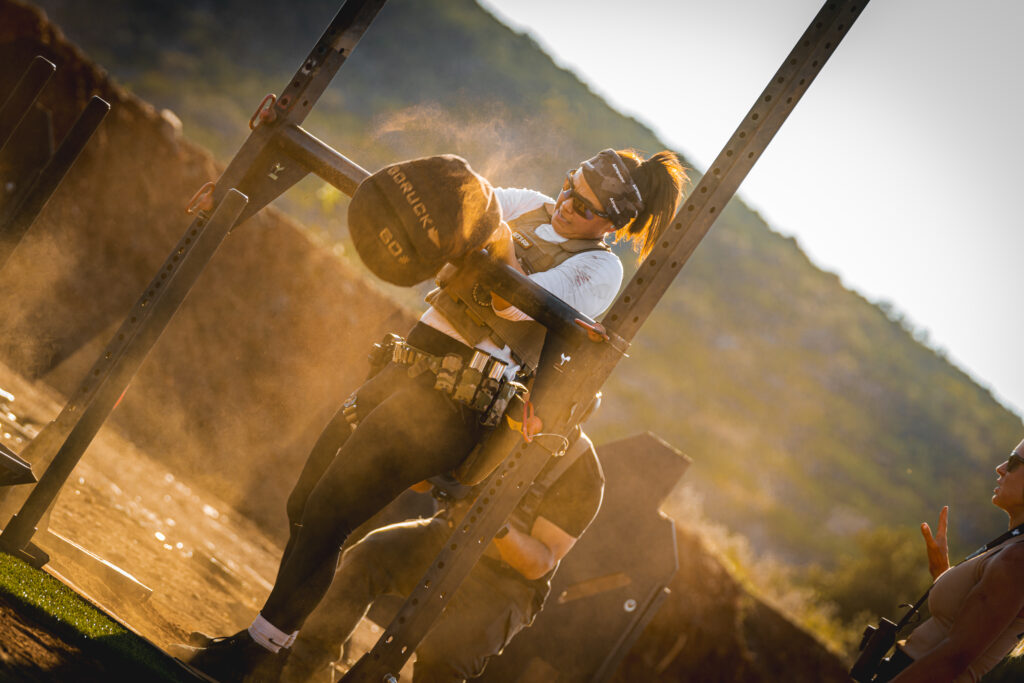
Safety and Match Etiquette: The Non-Negotiables
What Is the Cold Range Policy?
All Tactical Games events operate under a cold range policy. No loaded firearms unless you’re actively on the firing line under a Range Officer’s command.
- Rifles must have a chamber flag inserted at all times until instructed to remove it by an RO or Stage Coordinator. Moving around the range without a chamber flag in your rifle will result in disqualification.
- Pistols remain unloaded, hammer or striker down, and either holstered or bagged with no magazine inserted.
- Magazines can be loaded and stored in your gear or pouches, but the firearms themselves stay clear until you’re at the line.
What Are the Most Common Disqualifications?
Understanding what gets competitors disqualified helps you avoid costly mistakes. The four most common DQs are:
- Drawing too early: The most common DQ happens when competitors draw their firearm before reaching the designated firing line. Wait for clear instructions from the RO.
- Breaking the 180-degree rule: Your muzzle must never point uprange (behind the firing line) when the gun is loaded. This applies during movement, transitions, and reloads.
- Negligent discharge during clearing: Rushing through the clearing procedure and pulling the trigger without confirming an empty chamber. Slow down, verify clear, then drop the hammer.
- Turning around before your pistol is holstered: This builds off rushing through the clearing procedures. After clearing your pistols, ensure the pistol is back in your holster before coming off the firing line.
- Equipment failure (holster retention): Having your pistol fall out of its holster during movement or physical work. Your gear must retain your firearm securely throughout the entire stage.
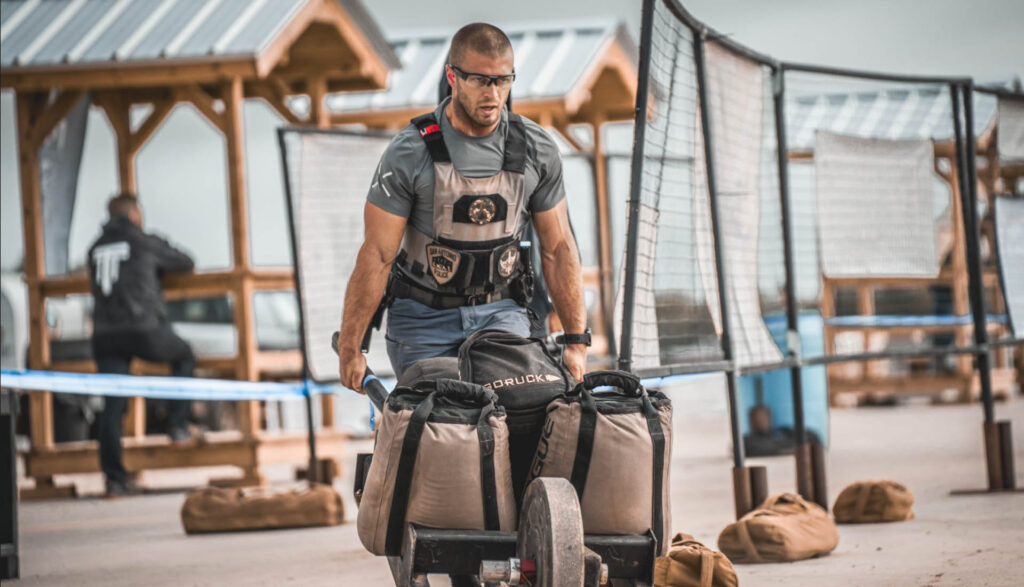
What Are Your Squad Responsibilities?
The Tactical Games uses a peer-judged structure. Each stage has a Range Officer to run the clock and oversee safety, but athletes act as lane judges for rep counts, penalties, and clearing procedures. You’ll judge immediately after finishing your heat—download your gear quickly and get back to judge the next athlete in your lane.
For shooting-only stages, you’re expected to help reset targets and props between shooters. Don’t disappear or stand around while others do the work. If you’re able to shoot, you’re able to help.
Choosing Your Division: Where Do You Fit?
The Tactical Games is structured to give everyone—from absolute beginners to seasoned athletes—a fair and challenging competition experience. Here’s how the divisions work:
Elite Division
The top tier. Athletes here are generally training specifically for this sport or competing at high levels in related disciplines—professional CrossFit athletes, special operations personnel, or those with extensive match history. Heavier implements, potentially longer stages (think long movement/run or ruck here), and less margin for error. If you want to compete for podiums, sponsorships, or qualify for Nationals with impact, this is where you’ll need to land eventually.
Tactical Division
Quickly becoming the standard division where most competitors land. Originally designed for active-duty military and law enforcement who could compete without sport-specific training, the Tactical division now serves as the middle ground between Intermediate and Elite. Solid baseline fitness and shooting ability required, but you don’t need to be training full-time for the sport.
Intermediate Division
The entry point. Scaled weights and stimulus with a “disassemble rule” that allows you to break down implements if you find them too heavy. Good fit for first-time competitors, shooters who are building fitness, or gym-goers who are still getting comfortable with firearms. Same required gear as other divisions.
Masters Divisions (40+, 50+, 60+)
Age-based divisions that allow you to compete against peers while still running full-weight stages. Men’s 40+ mirrors Tactical weights; Men’s 50+ mirrors Intermediate; Men’s 60+ scales slightly below Intermediate. Similar structure applies to Women’s divisions, but the 60+ won’t exist until they see enough growth in that age group.
Team Divisions
Some events are specifically set up for team competition, but they also accommodate and program for teams at solo events – it’s just not as competitive as the dedicated team matches. Men’s, Women’s, and Co-Ed options available.
For the full rundown of the Divisions for the Tactical Games, can be found here.
Quick self-check: Do you train 3-5 days a week and shoot regularly? Start in Tactical. Still building consistency in the gym or on the range? Intermediate is a safe choice. Consistent training, over 40 and still hungry? Check out Masters, but don’t go into it thinking it’ll be less competitive or easier.
Gear Requirements: What Do You Need to Compete?
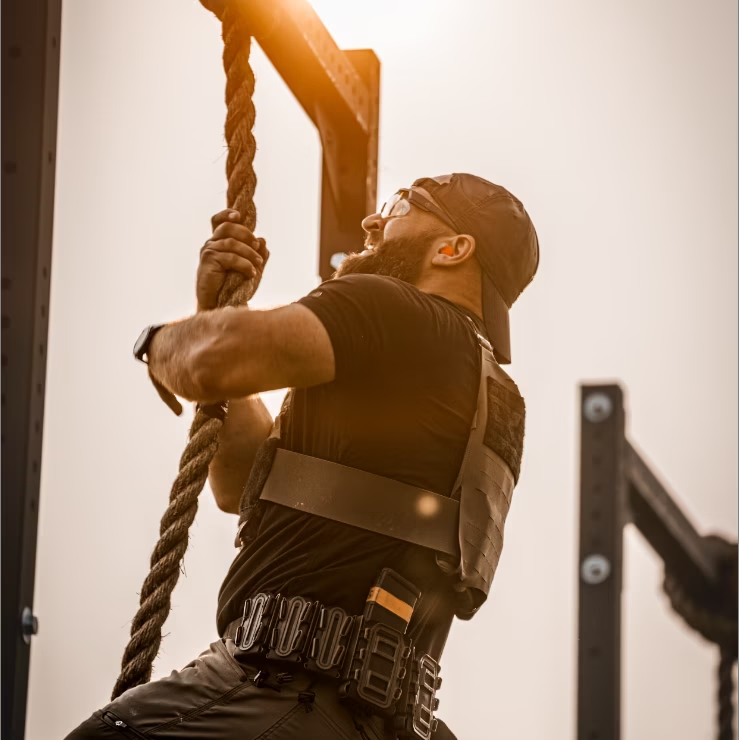
The Tactical Games doesn’t require exotic kit, but there’s a baseline you must meet to stay safe, functional, and in compliance with the rules.
Should You Buy New Gear Before Your First Event?
Going full-send on equipment purchases before you understand the sport is a huge mistake. You’ll see competitors at the top of the leaderboard running optimized gear—2011 pistols, lightweight race rifles, sport-specific plate carriers. That equipment matters at the margins when you’re competing for podiums. It doesn’t matter nearly as much when you’re learning how to pace a 10-minute stage or manage your breathing between shooting sequences.
The smart path is gradual upgrades based on your skill level, experience, and performance expectations. After a few events, you’ll know whether you’re losing time because your optic is hard to acquire under fatigue, or because your conditioning isn’t where it needs to be. Upgrade what’s actually holding you back, not what looks cool on Instagram.
What Gear Is Required?
Weapons & Ammunition
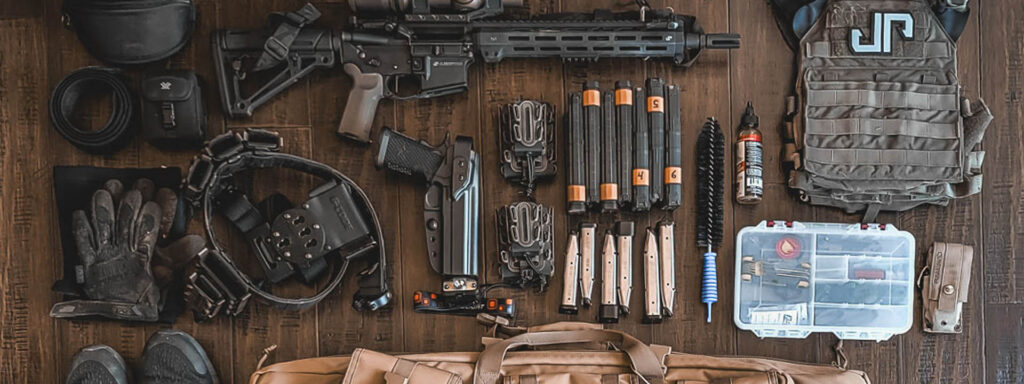
- Primary weapon: Rifle chambered in .223/5.56 or larger with an approved muzzle device
- Secondary weapon: Reliable semi-auto pistol
- Ammunition: At least 250 rounds per platform (confirm with match director)
- Magazines: At least 5 per weapon
- Chamber flag: Required for your rifle anytime you’re not at the firing line
Carrying Equipment
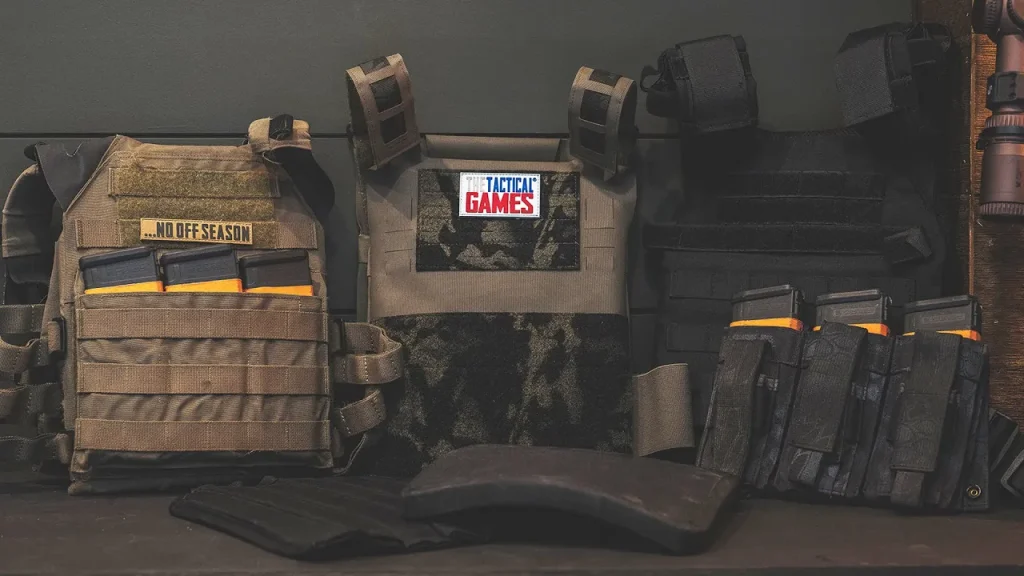
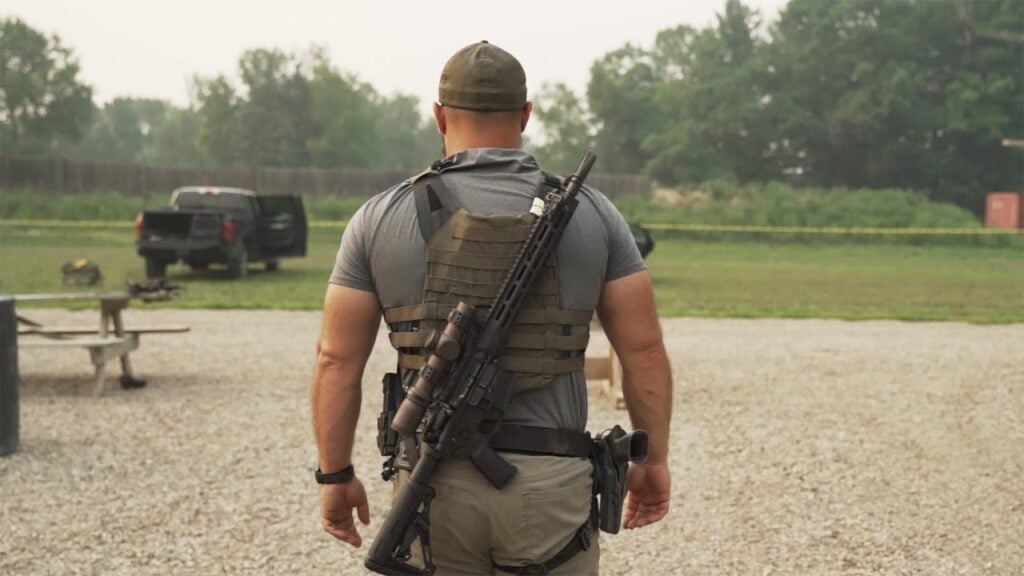
- Plate carrier: Men’s must weigh at least 15 lbs, Women’s 12 lbs (measured slick—no pouches, hydration, or other accessories)
- Holster: Must securely retain your pistol through vigorous movement. Hip-level or drop-leg. No appendix, small-of-back, fanny pack, or underarm setups.
- Rifle sling: Must be attached throughout the event
- Magazine pouches: Not specifically required, but you need to consider a way to carry up to 5 loaded mags during stages
- Eye and ear protection: Mandatory for all competitors on or near shooting stages (we shoot at steel, protecting your eyes from potential fragments coming back is extremely important
What About Optics and Equipment Optimization?
You’ll see competitors at the top running specific setups because the sport does reward certain equipment choices. Common rifle optic setups include LPVOs in the 1-8x to 3-18x range, often with offset red dots for close-range transitions. Pistol-mounted red dots are permitted in all divisions and help with target acquisition under fatigue.
Rifles tend to be lightweight, slick (no lights, lasers, or unnecessary accessories), and tuned for soft recoil. At the high end, you’ll see 2011 pistols because they’re more accurate than polymer striker-fired guns for bullseye-style shooting.
But here’s the thing: your Glock and stock AR with a red dot and 3x magnifier will work fine for your first several events. The equipment optimization matters at the margins—when you’re competing for podiums against athletes who have their fitness and shooting dialed in. If your conditioning fails you at the 6-minute mark of a 10-minute stage, a $5,000 pistol isn’t solving that problem.
The sport is hard on equipment. Rain, mud, dust, and repeated impacts from farmer carries and sled drags will test everything. Optics that hold zero, holsters that retain through burpees, and plate carriers that don’t shift during overhead movements—these matter more than brand names or price tags.
A Typical Competition Weekend: What Should You Expect?
Friday: Check-In and Preparation
Check-in typically runs from noon to early evening. Staff will inspect your weapons, gear, and verify that your plate carrier meets weight requirements. Staff will also check to see if you signed up for photos. If you have, they will put a tag on your plate carrier. You’ll receive your event t-shirt (one of the cool perks—each event has a unique design) and any other competitor materials. At some events, you don’t receive a t-shirt during check-in. However, on Saturday, check in with the Tactical Games main tent, and they should have the event t-shirts there.
Check your zero. Don’t skip this. The zero bay is usually open for the duration of check-in and throughout the match. Verify rifle at 50 yards, double-check your pistol, and change batteries if you’ve been putting it off. Show up to Saturday morning knowing your equipment is dialed.
Later that evening, you’ll receive an email with stage descriptions, the squad matrix (your schedule), and eventually your athlete number. Your athlete number tells you which squad you’re in and which lane you’ll occupy (e.g., 26-1 means Squad 26, Lane 1). Use this to figure out your stage brief times and launch times for Saturday.
Saturday and Sunday: Competition Flow
Each day starts with a mandatory safety brief where all competitors gather for location-specific protocols and emergency procedures. After the safety brief, you’ll proceed to your first stage brief for further instruction and await your launch time.
The rhythm is: attend stage brief, wait for your launch time, compete, download gear, judge the heat behind you, then move to your next stage. Time between stages can be quick (immediate rotation) or extended (90+ minute gaps). Be ready for either.
Managing downtime matters. Eat and hydrate constantly. Use breaks to stretch, foam roll, or reset your gear. Hit the vendor row if you need food or want to check out gear. Keep an eye on match staff for any schedule changes.
Training for Success: How Should You Prepare?
Ask anyone who’s done a match and they’ll tell you: you can’t fake your way through this. The Tactical Games demands real-world fitness and solid marksmanship under pressure—and the only way to deliver that on the clock is to train like it matters.
What Physical Training Do You Need?
This isn’t about having a massive bench or elite-level VO2 max. It’s about being able to work hard, recover fast, and keep going. Your training should prioritize functional strength and repeatable output.
- Carries: Farmer carries, sandbags, axle bars. Train grip endurance and posture under load.
- Sled work: Pushes and drags. Load it heavy, keep it moving. Builds total-body grit and teaches you to work through discomfort.
- Box step-overs: Weighted or bodyweight. Simulates stage movements under fatigue.
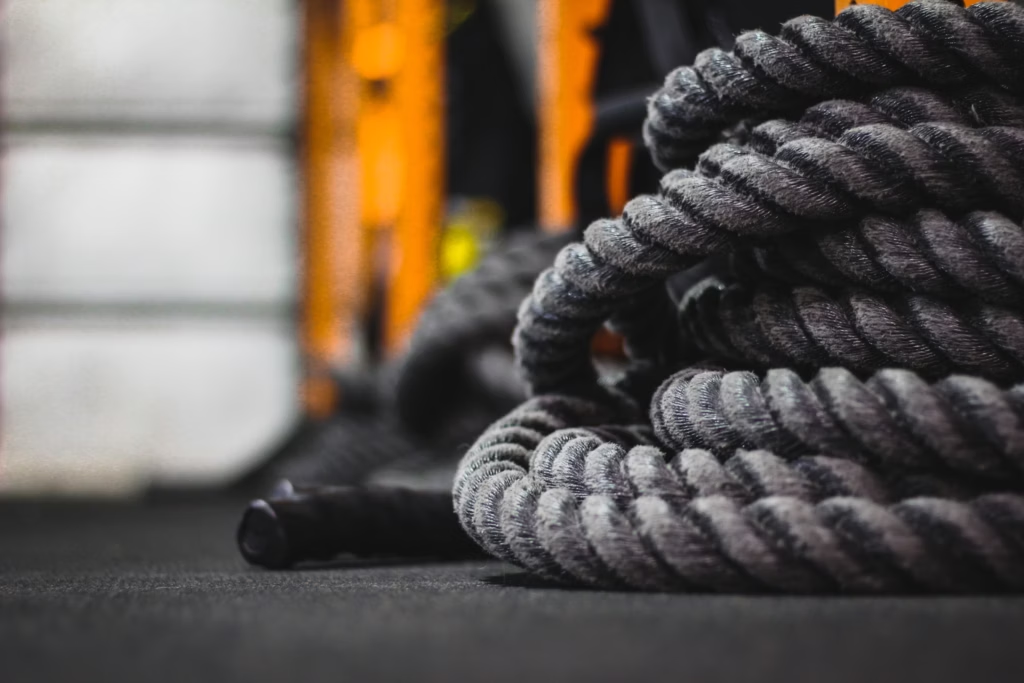
- Burpees, rope climbs, overhead holds: These movements appear regularly and crush the unprepared.
- Intervals and EMOMs: Push your heart rate up, then work on controlled movement or at least maintain form.
How Do You Train Marksmanship Under Fatigue?
It’s not enough to shoot well on a flat range. You need to shoot well when your hands are shaking, your chest is thumping, and sweat is dripping into your eyes.
- Dry fire after a short conditioning circuit
- Practice reloading and clearing while elevated (heart rate over 140 bpm)
- Alternate between strong-hand and weak-hand shooting drills
- Practice rifle-to-pistol transitions while moving
- Simulate clearing procedures under time pressure
Example session: 5-minute assault bike sprint intervals (30 seconds on, 30 seconds off), then transition into 3-round rifle dry fire at 25 yards with a par time. Simulated clear with verbal acknowledgment. Repeat for 3-5 rounds. This builds the exact skills you’ll need mid-stage when your judgment is compromised by effort.
Be very diligent and introspective with this, though. If you’re not paying attention or being honest with your dry fire, you’re at risk of developing poor shooting technique that’ll take even more work to reverse and correct down the road.
How Do You Simulate Match Conditions?
As match day approaches, shift from general fitness to match simulations. Wear your full kit during training. Time your dry fire reps. Use audible shot timers or beeps to trigger drills. Work in adverse weather if possible—rain or shine, the match will go on.
The more familiar you are with your gear, your fatigue threshold, and your shooting mechanics under pressure, the better you’ll perform when it counts.
The Importance of Live Fire
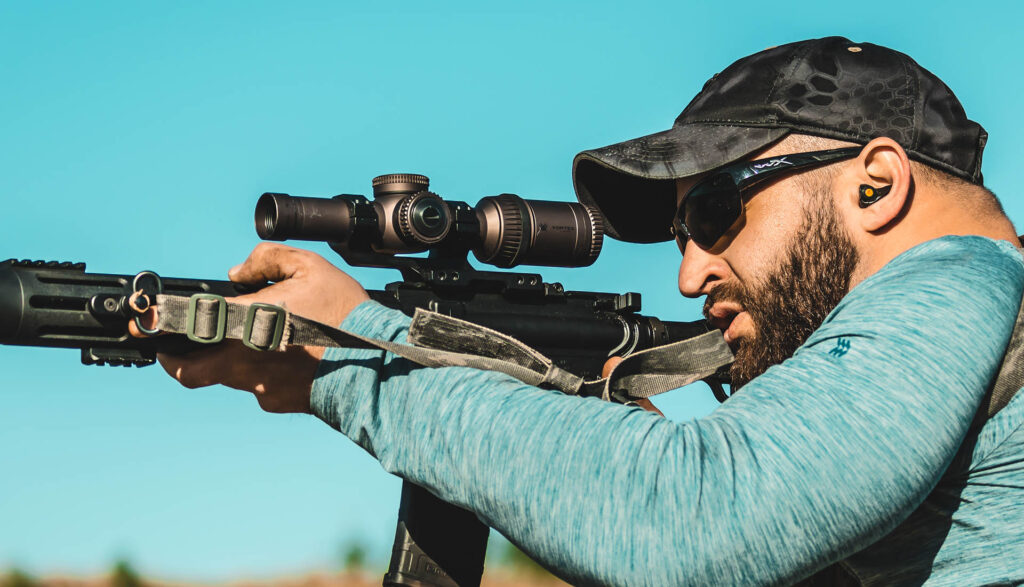
Dryfire is great, so great in fact, that all you see are constant recommendations, reminders, and (expensive) tools that encourage you to do it. What I see a lot of these recommendations miss is also attributing how important it is to mix in enough live fire for proper stimulus and feedback on your dry training.
Far too often, I see it as a recommendation to save costs on ammunition – which you can certainly do to an extent for things like manual of arms and weapon manipulations under stress and getting a baseline for trigger mechanics. What you cannot do, however, is become an extremely proficient shooter on just dryfire alone.
How much ammo do you need to burn to become proficient? That number varies for everyone, but I’d wager that as a newish competitor, you should expect to shoot at least 2 to 5,000 rounds to become intimately familiar with each platform and your capabilities with both rifle and pistol. It’s after that point, that you can truly hone in what should be worked on in dry fire training.
I’d equate dryfire to warming up and conditioning for a workout. It is entirely necessary, but that alone isn’t going to hit a PR. You need to be willing to invest the time and financials into putting actual rounds down range to reach true precision and performance.
Common Mistakes and Hard-Learned Lessons
Nobody walks into The Tactical Games perfectly prepared. Every match is a chance to learn, adapt, and get better. But some mistakes come up again and again—most of which are 100% preventable.
Preparation Mistakes
- Skipping zero check: Not verifying your point of impact during Friday check-in. Use the zero bay.
- New gear on match day: Wearing a brand-new belt or carrier with zero reps in it. Train in or with your match gear.
- Not reading stage briefs: Missing reps or shooting from the wrong positions because you didn’t study the description.
Competition Day Errors
- Rushing the clear procedure: Fumbling the unload process in a hurry leads to DQs. Slow down. Mag out, cycle the action, confirm clear, drop hammer on empty chamber, holster or ground, acknowledge clear.
- Relying on prescribed round count to determine “empty”: I’ve seen this one happen a number of times where a stage calls 10 rounds in the magazine. The competitor shoots and counts 10 rounds fired, rushes the clearing procedure and pulls the trigger on what should be an empty chamber only to be surprised by a round go off (they actually loaded 11 rounds). Luckily, it’s in a safe direction and into the berm, but unfortunately results in a match DQ. Always visually inspect your chamber to be clear before proceeding with the rest of the procedure. This is a fundamental safety practice and takes a split second to confirm.
- Going out too hot: Blowing out your heart rate in the first 30 seconds of a stage. Pace yourself—find a sustainable rhythm early so you can shoot clean and finish strong. You cannot out-fitness poor shooting.
- Dwelling on a bad stage: Letting one rough run mentally hijack the rest of your weekend. Every stage is a reset button.
- Neglecting fueling: Not eating, hydrating, or recovering between stages. Fuel early and often. Treat Saturday night like mission prep, not happy hour.
What Does It Cost to Compete in The Tactical Games?
Registration for a regional event runs around $400. That covers both days of competition, scoring, and the event shirt. But that’s just the starting point.
If you’re traveling—especially flying—expect a total weekend cost around $2,000 when you factor in flights, rental car, lodging, ammunition, and food. With only 10-11 regional events per year spread across the country, most competitors will need to travel.
That sounds like a lot, and it is. But context matters. Flying to compete in a major USPSA match will still run you $1,200+ between travel, lodging, ammo, and entry fees. The Tactical Games is actually comparable to or cheaper than events like Spartan Race when you account for what you’re getting—two full days of competition, professional timing and scoring, and access to a tight-knit community.
The cost is exactly why purposeful training matters. You don’t want to drop two grand on a weekend and show up unprepared. Build your fitness and shooting skills before that first regional, and you’ll get far more value from the experience.
After the Match: Learning and Growing
When the dust settles and the soreness kicks in, the real work begins. Post-match analysis is where you figure out what worked, what didn’t, and what needs more attention before the next event.
How Do You Review Your Performance?
Walk through each stage while it’s fresh. What did you execute well? Where did you struggle physically? Did your shooting fall apart under fatigue? Were there gear issues that slowed you down? Write it down and build clear training priorities.
Take photos of your targets after each stage to have as reference and match up with your performance notes. If you have the means, set your cellphone on a stand (out of the way) and record each of your stages. You won’t have up close details, but it gives you a running timecode to further pick out things you did well and any inefficiencies that could be addressed.
Talk to other competitors. Find someone who crushed the stage you struggled on and ask questions. Most people are happy to share insight about their approach, pacing strategy, or gear setup. Learning from squadmates is part of what makes this community special.
What's Next?
The biggest mistake I made going into my first event in 2019 was treating it as the finish line. I trained for that one specific match, showed up, competed, and then had nothing pulling me forward afterward.
Don’t do that. Think bigger. Set your initial goal further out—maybe it’s qualifying for Nationals, maybe it’s moving up a division, maybe it’s just stringing together three solid events in a row. Your first match isn’t the destination. It’s the baseline.
You’re going to return home beat up, sore, and needing recovery. That’s when it’s easiest to let momentum die. But that’s also when the real work starts. Review your performance while it’s fresh. Identify what broke down—your legs, your breathing, your shot calling under fatigue. Make honest adjustments to your training. Then get back after it.
Find your next event before the soreness fades. Register. Build your training around it. The Tactical Games rewards consistency and growth over time, not one-and-done efforts. Every match teaches you something new about your limits, your gear, and how you respond when things get hard. Reflect, reset, and come back better.
Ready to Test Yourself?
The Tactical Games will test every aspect of your preparation—your fitness, your shooting, your gear, and your mental game. It’s not easy, and it’s not supposed to be. But if you’re looking for a competition that demands everything you’ve got and rewards the work you put in, this is it.
Whether you’re coming from the fitness world curious about adding marksmanship, or you’re a shooter ready to add some serious physical punishment to your game, the format has a place for you. Start with a Skirmish if you want to dip your toes in, or jump straight into a regional if you’re ready for the full experience.
The community is welcoming, the challenge is real, and the lessons you learn about yourself will stick with you long after the last round is fired. Find an event, start training, and see what you’re really made of.
Want more tactical shooting insights and gear reviews tested under real competition conditions? Follow Action Gunner for in-depth coverage of competitive shooting sports, training tips from experienced competitors, and honest gear reviews that help you make informed decisions for your next match.
By Shawn Nelson
Shawn Nelson has competed in The Tactical Games since 2019, served as a Tactical Games Skirmish match director, and provided media coverage for the sport over the past five years. With over a decade of competitive shooting experience across multiple disciplines, he brings firsthand knowledge of what it takes to prepare for and compete in this demanding sport.