Let’s get something out of the way: you need a shot timer. If you’re serious about getting faster and more consistent, training without one is like lifting weights without tracking your reps. You might feel like you’re improving, but you have no idea if you actually are.
The problem? There are a dozen options out there ranging from $130 to over $300, and most reviews just regurgitate spec sheets without telling you what actually matters on the range. Some of the most expensive timers have features you’ll never use. Some of the cheapest have deal-breaking limitations that won’t show up until you’re standing at the line wondering why your timer won’t work for a 3-gun stage.
This guide covers seven dedicated shot timers I’ve either owned, borrowed, or used extensively at matches, plus a couple smartphone apps worth considering for dry fire. I’ll tell you exactly what works, what doesn’t, and which timer makes sense for your situation—not just which one costs the most.
Best overall for most competitors: Competition Electronics ProTimer BT ($189). It’s the workhorse you’ll find at clubs across the country for good reason—top-mounted display you can actually see on your belt, solid reliability, replaceable 9V battery, and a lifetime repair guarantee that actually means something. It does the job without overcomplicating things.
Best if money is no object: Kestrel KST1000 ($319). IP67 waterproof, military-grade drop rating, 999-second par time for any stage you’ll ever shoot, and a 5-year warranty. If you train in all conditions and destroy gear, this is the tank you want.
Best budget option: SG Timer GO ($165). Gets you the Shooters Global app ecosystem with video overlay capability at nearly half the price of the Timer 2. Just know it’s not weather-sealed and the quieter buzzer can be an issue at loud matches.
Critical warning for 3-gun shooters: The PACT Club Timer III maxes out at 99.99 seconds. If your matches use 180-second par times (which most 3-gun matches do), this timer literally cannot handle them. Keep reading before you buy.
Before diving into specific models, let’s talk about what features actually affect your training and match experience. A lot of the spec sheet stuff is noise.
This is probably the most overlooked feature when people shop for timers. When your timer is clipped to your belt during a practice session, can you actually see your time without unclipping it?
Top-mounted displays (ProTimer, PACT Club Timer, Kestrel, SG Timer GO) let you glance down and see your split or total time while the timer stays on your belt. This matters more than you’d think when you’re running drills solo.
Front-mounted displays (CED 7000, SG Timer 2) require you to either unclip the timer or do an awkward wrist rotation to see your results. The CED 7000 is the most popular timer in USPSA/IPSC specifically because ROs hold it in their hand anyway—but for personal training, it’s a minor annoyance.
Most USPSA and IDPA stages fall well under 60 seconds, so any timer handles them fine. But if you shoot 3-gun, multigun, or Tactical Games events, stages can run 180 seconds or longer. The PACT Club Timer III’s 99.99-second maximum is a hard limit that makes it unsuitable for these disciplines.
The Kestrel KST1000 goes up to 999 seconds. The SG timers are essentially unlimited. Everything else falls somewhere in between and handles standard match requirements.
If you can’t hear the start signal through your ear protection, you’re going to have problems. The CED 7000 and SG Timer 2 both hit around 110 dB—loud enough to cut through doubled-up ear pro at an outdoor match. The SG Timer GO drops to 99 dB, which some shooters find borderline in noisy environments. The AMG Commander sits around 105 dB, which can get lost in the chaos of a busy range.
Here’s where it gets real: most shot timers have zero weather sealing. The CED 7000, ProTimer, PACT Club Timer, SG Timer GO, and AMG Commander will all die if you get caught in a downpour. The Kestrel KST1000’s IP67 rating (submersible to 1 meter for 30 minutes) stands alone in this category. The SG Timer 2 claims water resistance but isn’t formally rated.
If you live somewhere it rains and you train outdoors, factor this in. A Ziploc bag works in a pinch, but it’s not exactly confidence-inspiring for a $150+ piece of gear.
Rechargeable lithium batteries (CED 7000, SG timers) are convenient until they die mid-match and you’re stuck. Replaceable batteries (ProTimer uses 9V, Kestrel uses CR123A, PACT uses 9V) mean you can throw a spare in your range bag and swap in 30 seconds. It’s a trade-off between convenience and field repairability.
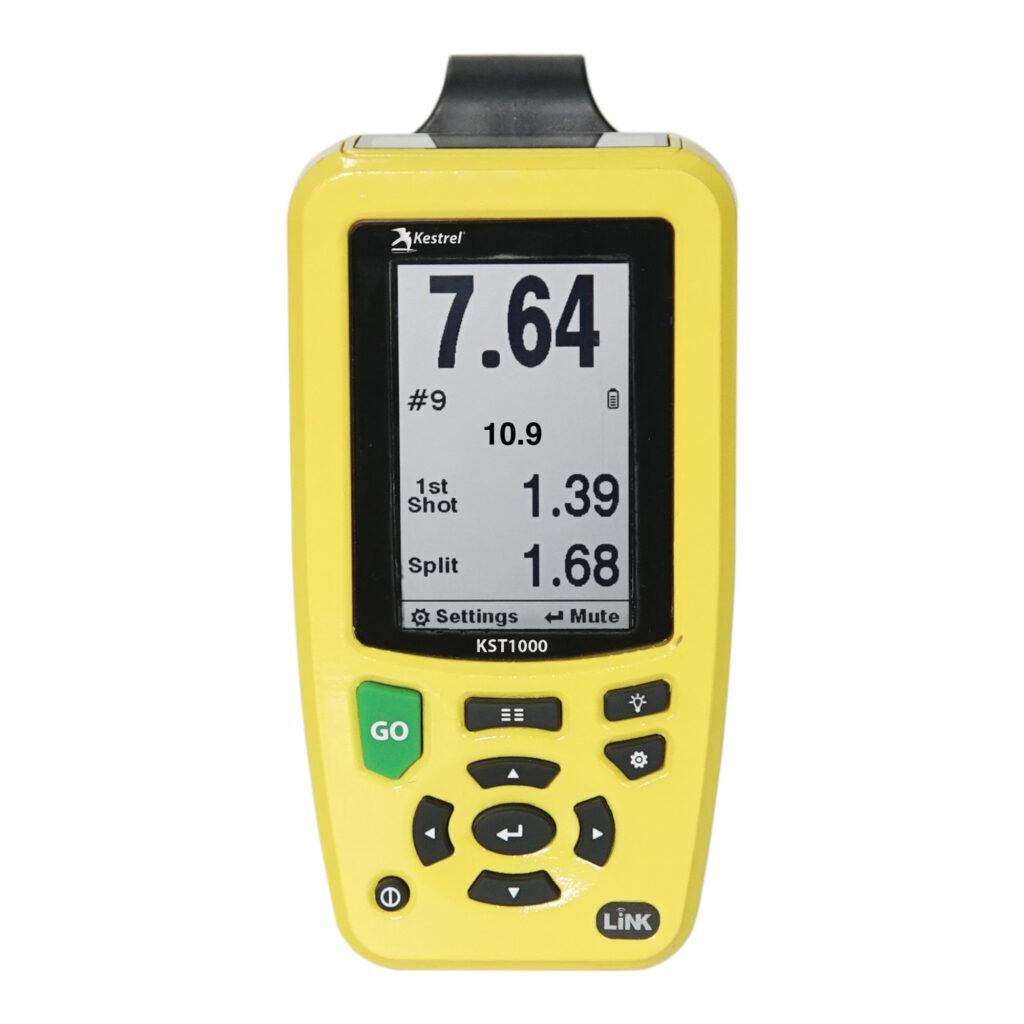
Kestrel made their name building weather meters that survive being dropped out of helicopters, and the KST1000 brings that same tank-like construction to shot timing. The IP67 waterproof rating and MIL-STD-810G drop testing make it the only timer here I’d feel confident using in genuinely bad conditions.
The dual-display design is clever—there’s a top-mounted screen showing shot count and splits for when it’s on your belt, plus a front display for detailed review. Both are backlit for low-light stages. Six factory sensitivity presets (Rifle, Pistol, .22LR, Suppressed, Suppressed .22, Dry Fire) eliminate the guesswork when switching between platforms.
Memory stores 50 strings of 150 shots each (7,500 shots total), which is massive compared to everything else. Par time goes to 999 seconds. The 5-year warranty backs it all up.
The catch: It’s $319 and uses CR123A batteries that aren’t as convenient as 9V. The yellow housing either looks rugged or obnoxious depending on your taste. And honestly, if you never train in the rain and don’t abuse your gear, you’re paying a premium for durability you might not need.
Best for: 3-gun competitors, shooters who train rain or shine, instructors, anyone who tends to destroy equipment.
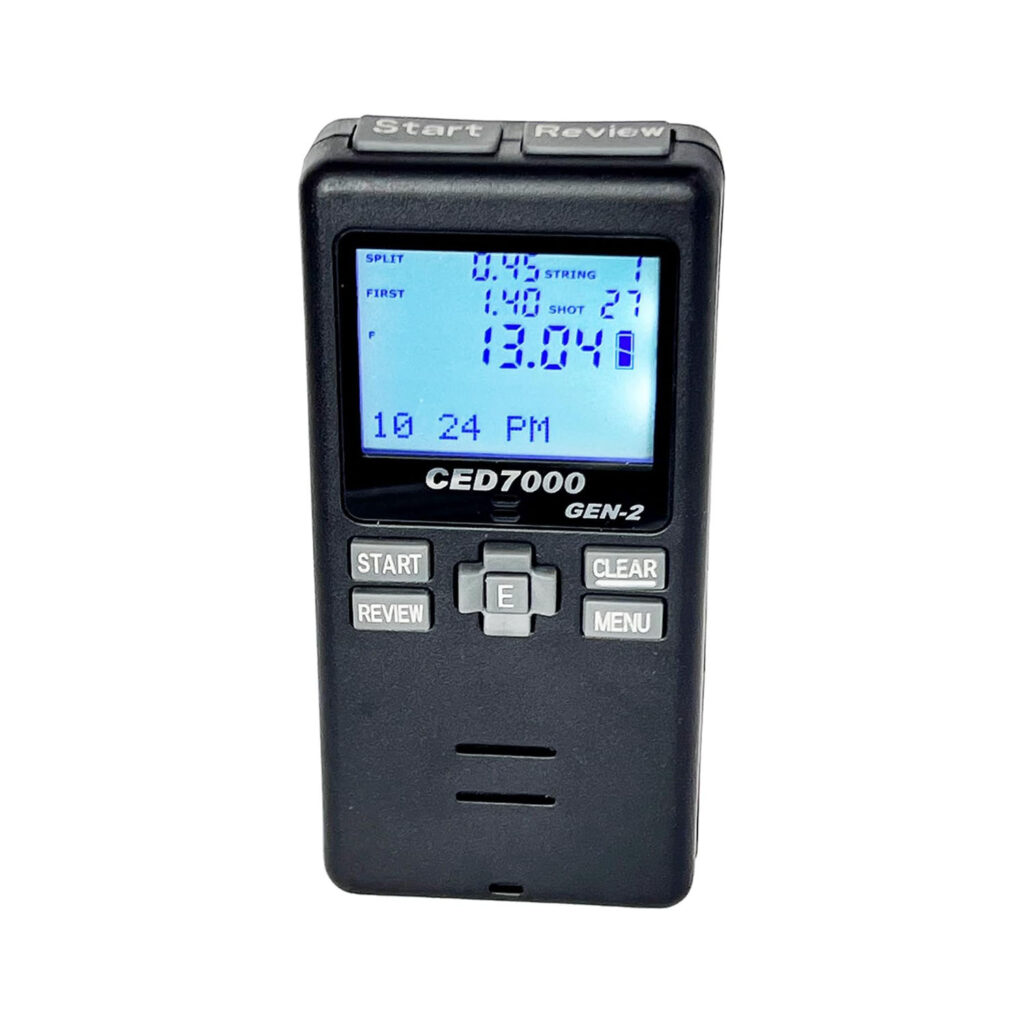
The CED 7000 is the de facto standard for USPSA and IPSC range officers worldwide. It’s compact enough to fit in a cargo pocket, the 110+ dB buzzer cuts through anything, and the GEN-2 version addressed earlier durability complaints with rubber buttons and Gorilla Glass protection.
Here’s my honest experience with the CED: the features are solid and I appreciate how much they packed into such a small package. The problem is build quality. The plastic housing feels cheap compared to the ProTimer, and the buttons on earlier units had a reputation for failing. The GEN-2 improvements help, but forum reports still show mixed longevity—some people run them for years, others go through multiple units.
The front-facing display is my biggest gripe for training use. When it’s clipped to your belt, you can’t see your time without pulling it off or doing an awkward twist. For RO duty where you’re holding it anyway, this doesn’t matter. For solo practice sessions, it’s annoying.
Also note: the belt clip is sold separately ($20-25), and I strongly recommend the silicone protective skin ($16) if you buy one. Neither is included in the box.
No weather sealing. I’ve seen these survive light mist, but don’t push it.
Best for: USPSA/IPSC match use, shooters who prioritize compact size, experienced competitors comfortable with the menu system.
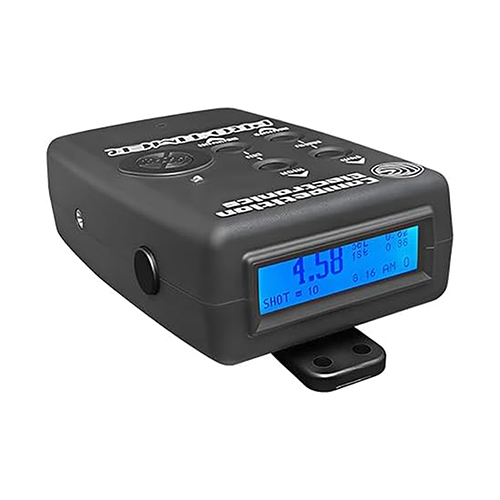
Competition Electronics has been building shot timers for over 30 years, and the ProTimer BT represents their current flagship. There’s a reason you see these at club matches everywhere—they just work.
The top-mounted display is immediately readable when the timer is on your belt. The blue backlit LCD is easy to see in any lighting. The included belt clip (a clothespin-style design) fits shooting belts securely. Battery is a standard 9V you can grab at any gas station. It stores 50 strings with timestamps, which is plenty for tracking progress across training sessions.
The Bluetooth connectivity syncs with PractiScore and the PTLink app for those who want digital record-keeping. The non-BT version ($168) drops that feature if you don’t care.
What really sets Competition Electronics apart is their repair policy: they won’t charge more than half the retail price to repair any current model, regardless of condition. That’s essentially a lifetime serviceability guarantee. When your timer eventually dies (and they all do eventually), you’re not starting from scratch.
The downsides: The plastic construction feels dated. No weather resistance (operates 30-110°F only). No accelerometer for filtering out environmental noise. It’s not sexy, but it’s reliable.
Best for: Club matches, personal training, shooters who value serviceability and simplicity over bells and whistles.
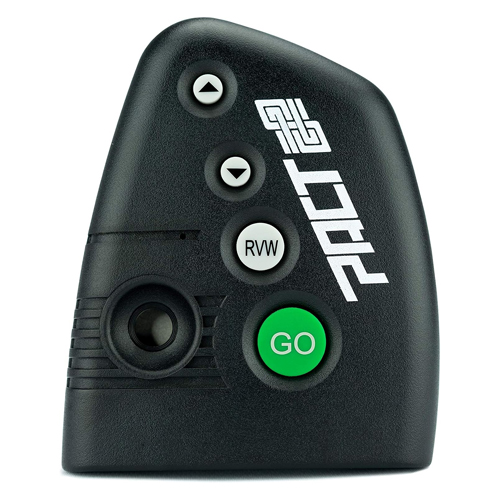
The PACT is about as simple as shot timers get. Hit GO, hear the beep, shoot, review your time. Made in the USA with a limited lifetime warranty. The top-mounted display works great for belt use.
Here’s the critical limitation: the par time maxes out at 99.99 seconds. PACT’s own documentation confirms this—if you need longer par times, they recommend their MKIV XP Timer/Chronograph instead. This makes the Club Timer III completely unusable for 3-gun or any discipline with stages exceeding 100 seconds.
For USPSA and IDPA where stages rarely exceed 60 seconds, this limitation doesn’t matter. And at $130, it’s hard to beat for basic training use. The sensitivity is adjustable via a screw under the battery compartment, which is clunky but functional.
No backlight on the display makes it harder to read in low light. No weather protection. Battery terminal issues occasionally pop up in forum discussions.
Best for: USPSA/IDPA-only shooters on a budget who want maximum simplicity.
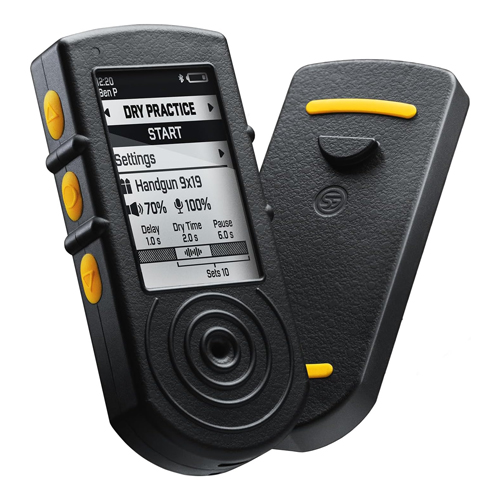
The SG Timer 2’s headline feature is genuinely innovative: video overlay. Through the Drills app on your smartphone, the timer syncs shot data to recorded video so you can see your draw time, splits, and total time displayed frame-by-frame over your actual footage. For technique analysis or coaching, nothing else comes close.
The 110 dB buzzer is among the loudest tested. The 2.6-inch OLED display looks great. Memory is essentially unlimited at 1,000,000 shots. USB-C and wireless charging are nice touches. Bluetooth range hits 260 feet.
“Spy Mode” is clever—the timer listens for another timer’s start beep and records your performance, useful when an RO is timing at a match but you want your own data synced to video.
The trade-offs: At $330, it’s the most expensive option here. The front-mounted display requires wrist rotation to view on your belt. The Drills app has a learning curve and requires registration. Some shooters find the feature set overwhelming when they just want a beep and a time.
Best for: Instructors, video analysis enthusiasts, serious competitors who want maximum data capture.
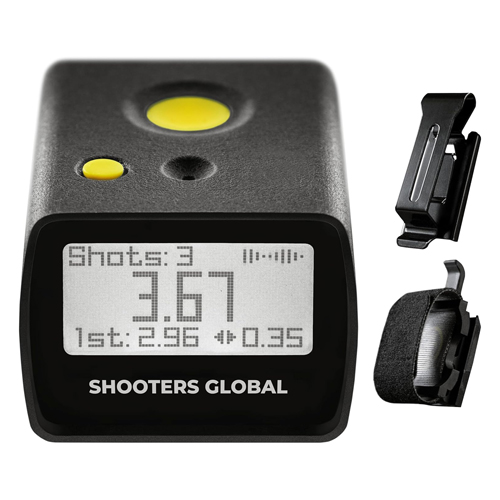
The GO gives you the Shooters Global app ecosystem—including video overlay—at roughly half the price of the Timer 2. The top-mounted display is actually an advantage for belt use, unlike the Timer 2’s front-facing screen.
Build quality is noticeably lower. The buttons are small and awkward with gloves. The 99 dB buzzer is 11 dB quieter than the Timer 2, which some shooters find marginal in noisy environments. No weather resistance whatsoever—users recommend a Ziploc bag for protection.
Heavy app dependency is the real catch. Without your phone connected, the GO becomes extremely basic—no shot review beyond 3 shots, no start signal adjustments, limited par time configuration. You’ll have your phone out constantly.
Best for: Dry fire training at home, budget-conscious shooters who want video analysis, solo practice sessions.
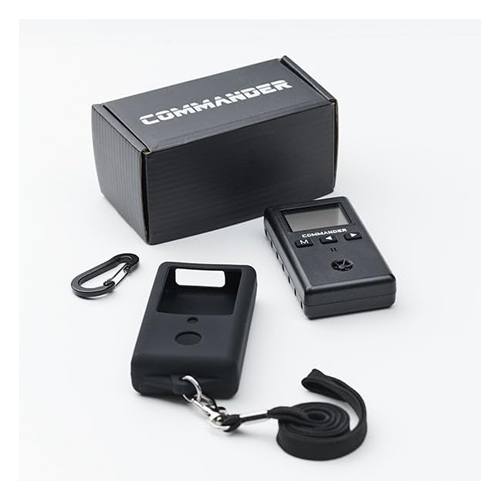
The AMG Commander claims “official timer of USPSA” status and pioneered Bluetooth PractiScore integration. The digitally adjustable sensitivity (10 levels) handles everything from suppressed .22 to dry fire without tools.
Why you don’t see more of these: availability. AMG Lab is reportedly a one-person operation, and wait times of 3-12+ months are regularly reported. BBB complaints mention orders charged immediately but shipping months later. If you want one, you might be waiting a while.
Technical limitations include only 3 strings of on-device memory (compared to 50 on the ProTimer or 7,500 on the Kestrel). The 105 dB buzzer is quieter than competitors. No backlight. The mic and display are on the same side, awkward for ROs who need to point the mic at shooters while reading times.
Best for: Dry fire practice, shooters already in the PractiScore ecosystem, patient people willing to wait.
| Timer | Price | Display | Max Par | Weather | Battery | Best For |
| Kestrel KST1000 | $319 | Dual | 999 sec | IP67 | CR123A | Durability, 3-Gun |
| SG Timer 2 | $330 | Front | Unlimited | Resistant | Li-Po | Video analysis |
| ProTimer BT | $189 | Top | Standard | None | 9V | Club matches |
| CED 7000 GEN-2 | $140 | Front | Standard | None | Lithium | Compact, RO use |
| SG Timer GO | $165 | Top | Unlimited | None | Li-Po | Budget video |
| PACT Club III | $130 | Top | 99.99 sec | None | 9V | USPSA budget |
| AMG Commander | $189+ | Front | Long | None | 4×AAA | Dry fire, data |
Phone apps can work as par timers for dry fire practice, but they have real limitations you need to understand before relying on them.
Speaker volume is the main problem. Your phone’s speaker doesn’t come close to a dedicated timer’s 105-110 dB buzzer. Through ear protection, app beeps can be hard to hear reliably.
Shot detection is inconsistent. Phone mics struggle with striker clicks from guns like Glocks, and live fire detection is plagued by missed shots, echo false positives, and triggering from adjacent shooters. Every review I found confirms apps are inferior to hardware for live fire.
That said, for dry fire practice in your basement, a free app is better than nothing. Here are the ones worth considering:
Splits (Android, Free): The clear winner among free apps. Records splits, saves drill data, tracks performance over time. Use par time mode with sensitivity maxed for dry fire. Works surprisingly well outdoors for live fire, though indoor echo remains an issue.
IPSC Shot Timer (Android, Free): Made by Shooters Global. Par time, random delay, and echo filtering for indoor use. Good for dry fire with sensitivity cranked up.
ShootOnTime (iOS, Free): Does one thing well: par times. Supports up to 4 sequential par splits, loop mode, and runs in background. Does NOT detect shots—it’s purely a countdown timer for draw and reload practice.
If you’re serious about dry fire and want dedicated hardware, the AMG Lab Sidekick ($60) reliably detects striker clicks and outperforms any phone app.
A quick search on Amazon or eBay will show dozens of shot timers from unknown brands at prices that seem too good to be true. They usually are.
These timers haven’t established any track record for accuracy or durability in match conditions. When your stage time matters—whether for classification or personal tracking—you need to trust that every shot is being recorded correctly. A timer that misses shots or records phantom triggers isn’t just annoying; it actively undermines your training.
Save up for a proven option. The PACT Club Timer III at $130 is the floor for anything I’d recommend for actual competitive use.
USPSA/IDPA: The ProTimer BT ($189) hits the sweet spot. Top-mounted display, solid build, great repair policy. If you want to save money, the CED 7000 ($140) works fine for match use—just budget for the belt clip and protective skin.
3-Gun/Multigun: Eliminate the PACT Club Timer III immediately—its 99.99-second limit cannot handle standard 180-second par times. The Kestrel KST1000 ($319) is the safest choice with 999-second capability and weather resistance for outdoor matches. The SG Timer 2 ($330) or GO ($165) also work if you don’t need the rugged build.
PRS/NRL Precision: Kestrel KST1000. The brand carries weight in precision circles (Kestrel makes the industry-standard ballistic computers), and the IP67 rating suits field conditions.
Instructors/Coaches: SG Timer 2 ($330). The video overlay feature is a game-changer for recording student runs with synchronized timing data. Nothing else offers this.
Dry Fire Focus: AMG Lab Sidekick ($60) for hardware, or the Splits app (free) if you just need a par timer. The SG Timer GO ($165) works if you want video integration.
Tight Budget: PACT Club Timer III ($130) for USPSA/IDPA only. SG Timer GO ($165) if you shoot anything with longer stages or want app connectivity.
If you’re competing and want to improve, yes. Without timing data, you can’t identify whether your changes are making you faster or slower. Feeling fast and being fast are different things.
For dry fire par timing, phone apps work fine. For live fire or any official scoring, use a dedicated timer. Phone mics can’t reliably detect shots, and phone speakers aren’t loud enough through ear protection.
For USPSA and IDPA, stages rarely exceed 60 seconds—any timer works. For 3-gun, you need at least 180 seconds. The PACT Club Timer III’s 99.99-second max is a disqualifying limitation for multigun.
If you train in all weather conditions, shoot 3-gun, or tend to destroy gear, the IP67 waterproofing and 5-year warranty justify the premium. If you only train on nice days and take care of your equipment, the ProTimer BT at $189 does everything you need.
It’s genuinely useful for technique analysis—seeing exactly when your splits happen relative to your movements reveals things you’d otherwise miss. For most recreational competitors, it’s a “nice to have.” For instructors or serious skill development, it can justify the price of the Timer 2.
Availability. AMG Lab is reportedly a one-person operation, and wait times of 3-12+ months are common. The product itself is solid for dry fire and training data, but you need patience to get one.
A shot timer is one of those pieces of gear where the right choice depends entirely on how you train and compete. The Kestrel KST1000 is objectively the most capable timer here, but if you only shoot USPSA on sunny days, you’re paying for features you’ll never use.
For most competitors, the Competition Electronics ProTimer BT offers the best balance of features, reliability, and value. It does the job without overcomplicating things, and the repair guarantee means you’re not starting over when something eventually breaks.
Whatever you choose, the important thing is to actually use it. A cheap timer you train with consistently beats an expensive one sitting in your range bag. Get something that fits your discipline and budget, then put it to work.
See you at the range.
Disclosure: ActionGunner is not affiliated with any of the manufacturers mentioned in this article. All opinions are based on personal experience and community feedback. We may earn a small commission if you purchase through affiliate links at no additional cost to you.