
Your competition gun, a shot timer, and honest self-assessment will always be the foundation. Here’s how the gear stacks up when you’re ready to add to your toolkit.
Let’s get something straight before we dive in: you don’t need to spend hundreds of dollars on fancy electronics to get better at shooting. The world’s best competitive shooters built their skills with an unloaded gun, a timer, and scaled targets taped to a wall. That hasn’t changed.
What has changed is the variety of tools available to supplement that foundation. Some of these tools provide genuine value for specific training needs. Others look cool but can actually hurt your development if you’re not careful.
I’ve spent time with all of these systems, and I’m going to give you the honest rundown—what works, what doesn’t, and what might actually create training scars that follow you to the range. Because here’s the thing nobody selling these products will tell you: every single one of these systems has potential downsides. The key is knowing what they are so you can train around them.
Dry fire is practicing with an unloaded firearm. No ammunition, no noise, no recoil—just you, your gun, and the fundamentals. You’re rehearsing draws, trigger presses, reloads, transitions, and movement without burning through your ammo budget.
Why does it work? Because shooting is a motor skill. Your brain doesn’t actually need live rounds going downrange to build the neural pathways for a smooth draw or a clean trigger press. What it needs is repetition—thousands of reps—and dry fire lets you stack those reps without spending $0.30 per trigger pull.
The catch? Dry fire without feedback can reinforce bad habits just as easily as good ones. If your grip is garbage, you’ll just get really good at a garbage grip. That’s where training systems come in—they can provide feedback you might miss on your own. But they can also focus your attention on the wrong things.
The bottom line: no dry fire system replaces live fire validation. Period. Whatever system you use, you need regular range time to confirm your dry practice is actually translating to hits on target.
Dry fire training systems fall into distinct categories, each with different strengths and trade-offs. Here’s how they break down:
Books and Programs: Structured training with your actual firearm. Lowest cost, highest skill ceiling, requires the most self-discipline.
Motion Analysis Sensors: Devices that track your firearm movement and provide diagnostic feedback on trigger control and stability.
Laser Cartridges and Target Systems: Projectile-free visual feedback showing where your shot would have landed.
Trigger Reset Devices: Magazine replacements or bolt carrier systems that reset your trigger without racking the slide.
Recoil Simulators: CO2-powered systems that cycle your slide and simulate felt recoil.
VR Simulation: Virtual reality stage simulation with replica handsets and scored performance.
Before you spend a dime on electronics, you need a solid dry fire program. The best option hasn’t changed in years.
Price: Generally under $30
Ben Stoeger is an 8-time USPSA Production National Champion and 2017 IPSC World Champion. When he writes a book on dry fire, it’s worth paying attention.
DryFire Reloaded isn’t a gadget—it’s a methodology. The book provides structured drills for every fundamental skill: draws, reloads, transitions, trigger control, and movement. Each drill comes with par times derived from Grand Master-level performance, so you know exactly what you’re shooting for.
Using scaled targets (1/3 and 1/6 scale USPSA/IDPA templates) let you simulate realistic distances in your living room. A 7-yard shot on a 1/3 scale target at 2.3 yards requires the same visual acuity and precision as the real thing.
What you’ll need to use this system effectively: your competition gun, dummy rounds or snap caps, a quality shot timer (or app), and the printed scaled targets. Total investment: roughly $50-80 all in, including the book.
The catch: This approach requires brutal self-honesty. There’s no electronic feedback telling you that you pushed the shot. You have to watch your sights, feel your trigger press, and know when you screwed up. That’s hard. It’s also exactly the skill you need to develop for match performance.
Who it’s for: Every competitive shooter, regardless of what other systems they use. This is your foundation. Everything else is supplemental.
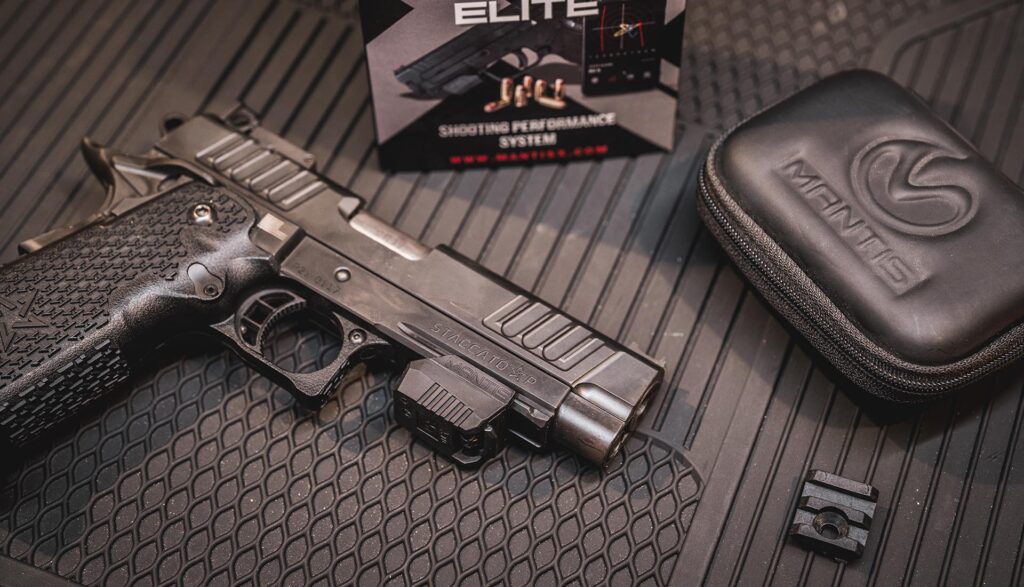
Your eyes can’t track micro-movements in your trigger press. Motion sensors can. When used correctly, these tools help identify specific mechanical issues you’d otherwise miss.
Price: $250 (mid-range investment)
The Mantis X10 Elite has become the most respected electronic training aid among serious competitors. This small sensor attaches to your pistol’s accessory rail and tracks micro-movements through your entire trigger press cycle.
The app breaks down your movement before, during, and after the shot breaks. It shows you if you’re pushing left, pulling right, anticipating recoil, or any of a dozen other common errors. The muzzle trace visualization is particularly useful—you can literally see the path your sights traveled.
For draw work, the holster analysis feature breaks your presentation into phases: grip acquisition, pull, horizontal travel, and trigger press. You get data on each segment, letting you identify exactly where you’re losing time.
The X10 works in both dry and live fire, which is genuinely valuable. In live fire mode, the recoilmeter tracks muzzle rise, recoil angle, and recovery time. Mounting options include direct Picatinny attachment, MagRail adapters for magazine baseplates, and barrel mounts for long guns. No subscription fees.
The catch: The diagnostic wheel operates on a bullseye paradigm—it’s optimized for minimizing movement, period. Some argue this doesn’t perfectly translate to acceptable sight picture shooting where you’re pressing when the sights are “good enough” for an A-zone hit. The system also doesn’t track multi-target transitions—you’ll still need a par timer for array work.
Training scar risk: Getting too focused on perfect scores rather than match-applicable skills. The Mantis rewards minimizing all movement, which can slow you down if you start treating every shot like a bullseye competition. Use it as a diagnostic tool to identify specific problems, not as a replacement for your training program.
Who it’s for: Shooters who have plateaued and need objective data to identify what’s holding them back. Particularly valuable for diagnosing trigger control issues and optimizing draw strokes.
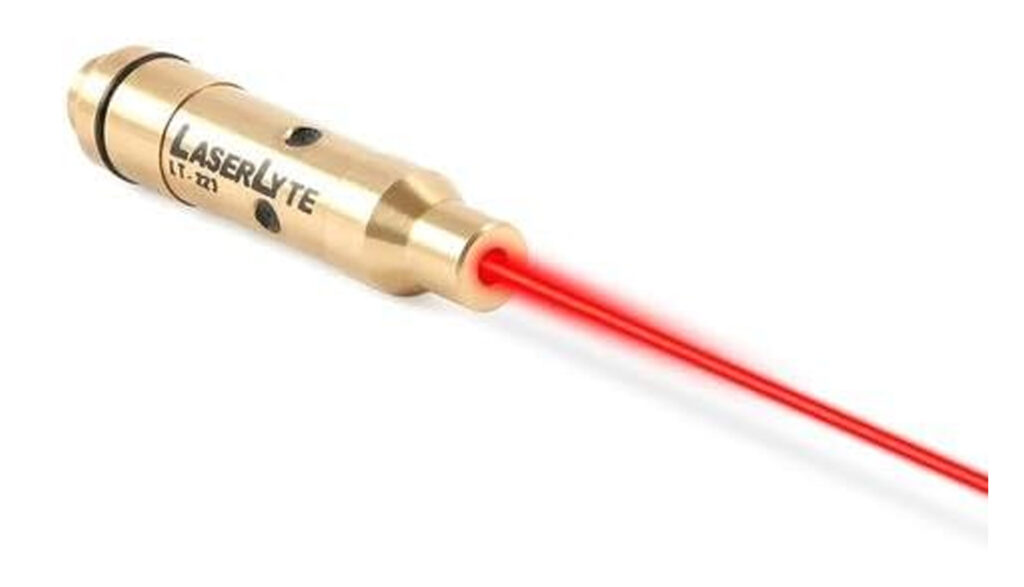
Laser cartridges insert into your chamber and project a dot when your firing pin strikes. Combined with target systems, they provide immediate visual feedback on shot placement. The technology has matured significantly, but the fundamental trade-offs remain.
Price: $159-179 for the Standard Training Kit (mid-range investment)
The Mantis Laser Academy combines their Pink Rhino laser cartridge with smart targets and a smartphone app for shot detection. The kit includes 31 training drills covering draw speed, transitions, and various challenge modes. One-time purchase with no subscription required.
What sets the Pink Rhino cartridge apart is its firing-pin activation—the laser fires when your striker or hammer hits the cartridge, not from a pressure switch. This provides more realistic trigger engagement. The rimless design allows semi-auto slides to close normally without extraction issues.
The system uses your smartphone camera to detect laser hits, which works reasonably well in controlled lighting. Drill variety is solid, including USPSA and IDPA target templates. Pink Rhino cartridges run about $40 each and cover most competition calibers: 9mm, .380, .40 S&W, .45 ACP, and .223/5.56.
The catch: You still have to rack the slide between shots on striker-fired pistols. Camera-based detection can be temperamental depending on lighting conditions. Effective range is limited to about 3-5 yards indoors.
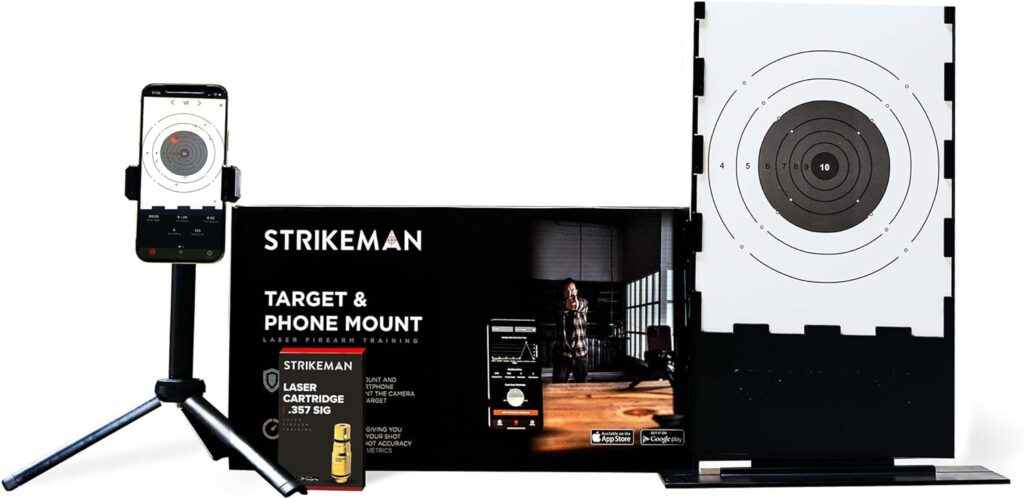
Price: $87-125 (budget-friendly)
Strikeman offers a lower-cost entry into laser training with a similar smartphone-camera approach. The system includes a laser cartridge, target, and tripod. The app tracks shot placement and provides basic scoring.
At this price point, it’s accessible for shooters wanting to experiment with laser feedback before committing to more expensive options. The Pro subscription ($10/month) adds features that come standard with Mantis.
The catch: Competitive shooters consistently report that Mantis offers superior shot tracking accuracy, more drill variety, and better-designed competition-specific targets. If you’re serious about competition, you’ll likely outgrow Strikeman quickly.
Here’s what nobody selling laser systems wants to talk about: they can train you to focus on the wrong thing.
In proper pistol shooting, your visual focus should be on your front sight (or dot), not the target. But when you’re using a laser system, it’s incredibly tempting to watch the target for the laser impact. This creates a “peekaboo effect”—looking at where you hit immediately rather than maintaining proper sight picture through follow-through.
The other issue is that laser systems show you where your shot went but not why. You see a hit low-left, but was it trigger pull, grip pressure, anticipation, or something else? Without the diagnostic capability of something like the Mantis X10, you’re just seeing the symptom, not the cause.
Mitigation: Use laser systems primarily for draw work and first-shot accuracy rather than sustained fire sequences. Resist the urge to immediately look at the target after the shot—maintain your sight picture as you would in live fire.
One of the biggest interruptions in dry fire is racking the slide between every trigger press. These devices solve that problem, letting you practice multiple trigger presses without breaking your grip.
Price: $99 (mid-range investment)
The DryFireMag replaces your magazine with a spring-loaded mechanism that interfaces with your trigger bar, providing automatic trigger reset without touching the slide.
Insert the magazine, rack once to cock the striker, and you’re set for unlimited trigger presses. The trigger feel approximates a 5.5-6 pound factory pull in stock configuration, and spring kits let you adjust the weight. There’s an audible click on reset that differs from an actual striker drop, but it’s close enough for building muscle memory.
The DryFireMag works with Glock (17, 19, 34, 45, and most double-stacks), SIG P320 family, Smith & Wesson M&P series, and Springfield XD models. Each platform requires its own purchase—there’s no universal version.
The Smart DryFireMag ($299-305) adds an integrated laser with electronic trigger-break detection, compatible with Mantis Laser Academy and similar target systems.
The catch: The magazine does not drop free on release—it has to be stripped from the pistol. This makes the DryFireMag completely unsuitable for reload practice. You need separate dummy magazines for reload drills.
Not supported: DA/SA pistols (CZ Shadow 2, Beretta 92, 1911/2011 platforms), Walther models, and revolvers.
Who it’s for: Shooters focused on trigger mechanics, rapid reset drills, and high-volume trigger work without the fatigue of constant slide manipulation.
Price: $199-249 for standard models, $299-349 for BlackbeardX (mid-range to premium investment)
The Mantis Blackbeard is the dominant dry fire solution for AR-15 shooters. It’s a drop-in bolt carrier group that catches and resets your hammer electronically, powered by a battery in a magazine insert. Installation takes about 20 seconds: remove your standard BCG and charging handle, drop in the Blackbeard unit, insert the powered magazine, and you’re training.
The system uses your actual trigger—same weight, break, and reset—which eliminates muscle memory conflicts from training on different setups. Battery life is impressive: 50,000+ shots per charge, with capability for 10 shots per second if you can pull the trigger that fast.
Laser-equipped models (red $219, green $249, IR $249) project point-of-impact for visual feedback. The BlackbeardX variant integrates a MantisX sensor into the magazine, adding motion analysis and app-based coaching.
Platform support has expanded beyond standard AR-15 to include AR-10, SIG MCX, and FN SCAR 16S/17S variants. An AK-47/74 version is in development.
The catch: There’s no bolt movement, no recoil, and no reciprocating mass. You’re training trigger mechanics in isolation without the rifle’s normal feedback. For 3-Gun competitors especially, this means your split times and transitions in dry fire won’t match your live fire performance.
Training scar risk: Getting accustomed to pressing the trigger without managing recoil or tracking the bolt cycle. Your brain expects certain feedback when you fire a rifle—remove that feedback entirely, and you may develop timing issues. Validate with live fire regularly.
Who it’s for: 3-Gun and multigun competitors who need high-volume rifle dry fire capability. Essential for practicing target arrays, sight offset for close targets, and magazine exchanges.
Price: $315-450 depending on model (premium investment)
The CoolFire Trainer is as close to live fire as dry fire gets. It’s a drop-in barrel replacement that uses CO2 to cycle your slide and simulate recoil impulse using your actual competition pistol.
The system replaces your barrel with a bright red CO2 reservoir barrel and includes a modified recoil spring assembly. When you press the trigger, the striker activates a valve releasing CO2, which drives a piston that cycles the slide. You get automatic trigger reset, slide movement, and tactile recoil feedback—all in your actual holster setup with your actual trigger.
Over 130 pistol models are supported, including competition favorites: Glock 17/19/34 (Gen 2-5), CZ Shadow 2 and SP01, SIG P320 and X5 Legion, Tanfoglio/EAA Witness Elite, and 1911/2011 platforms. A CoolFire Sidekick for AR-15 was announced at SHOT Show 2025, expected Q2 2025 at $400-600.
Recoil feel sits somewhere between .22 LR and 9mm—USPSA Grand Master Steve Anderson described it as roughly equivalent to light handloads in minor power factor divisions.
The catch: CO2 management is the system’s primary hassle. You get about 10-15 full-recoil shots per barrel fill, which means frequent refills that interrupt training flow. A coffee cup warmer ($15-25) is essentially mandatory—cold CO2 produces inconsistent pressure and unreliable function. Ongoing costs include striker tips (which wear out every 50-200 shots) and CO2 refills. Using a SodaStream adapter and tank brings per-shot cost to about $0.015 after initial investment.
Training scar warning: The recoil direction is wrong. The sight picture dips below your aiming point rather than rising as it would with live fire. For advanced shooters who track sight picture through recoil, this can create muscle memory issues. The system excels for grip development, flinch prevention, and draw practice—not for advanced sight tracking work.
Total system investment: $425-475 for essential setup (base kit + SodaStream adapter + tank + warmer + extra striker tips).
Who it’s for: Shooters who want the most realistic handgun dry fire available. Particularly valuable for grip development, managing recoil anticipation, and training with your actual competition setup.
Price: $649-1,000+ total system cost, plus $14-19/month subscription (premium investment)
Ace Virtual Shooting is the most advanced dry fire training system available—and also the most expensive. It’s a VR-based shooting simulator with weighted replica handsets, official USPSA classifiers, and all 8 Steel Challenge stages rendered in 1:1 scale.
The system requires a Meta Quest 2/3/3S headset ($199-499) plus a proprietary Ace Handset ($199) designed to replicate specific competition pistols: Shadow Systems MR920, Staccato P, SIG P320 X5 Legion, or SIG P365 X-Macro. Handsets feature self-resetting triggers (3-4 lb break with tactile reset) and fit actual race holsters—the Staccato P handset works with Double Alpha and Weber Tactical holsters designed for that frame.
The immersive experience is genuinely impressive. You can walk through stages, visualize positions, and work transitions at full speed. USPSA Grand Master Rob Epifania provides endorsement: “Ace’s visual recoil is even more demanding than actual firearms recoil… The lack of physical recoil isn’t a limitation. Visual discipline is crucial, and Ace excels at helping you train that.”
Users report documented skill transfer: draw times improving dramatically within weeks, better transitions, and improved stage visualization. Active members average over 4,700 trigger presses monthly—volume that’s difficult to match at the range.
The catch: The system is pistol-only—no rifle, shotgun, or PRS support exists. 3-Gun competitors can only train pistol portions. The magazine doesn’t physically drop; reloads involve button presses rather than actual manipulation. There’s no custom stage builder yet; you’re limited to included content.
Training scar warning: The leaderboard system can promote exactly the kind of training you should avoid. Per NRA Shooting Sports coverage: “The leaderboard can trick you into chasing scores instead of building skills… A lot of top scorers are basically gaming the system by starting from high ready.” If you’re training from holster for competition, don’t let leaderboard positions tempt you into high-ready starts that don’t transfer to matches. There’s also no tactile feedback for grip pressure—you can squeeze the controller incorrectly and still shoot well in VR.
Who it’s for: USPSA and Steel Challenge competitors who want to run specific stages and classifiers with unlimited reps. The stage visualization and transition training are genuinely valuable if you resist the temptation to game the system.
Here’s my honest assessment based on where you are in your competitive shooting journey.
Get Ben Stoeger’s DryFire Reloaded, a quality shot timer, and dummy rounds. Learn to practice with your actual competition gun and scaled targets. This is your foundation regardless of what else you add. Total investment: $50-80.
If you’ve been training consistently and hit a plateau, the Mantis X10 Elite ($250) provides objective data about what you’re doing wrong. Use it as a diagnostic tool to identify specific issues, then address them with focused practice. Don’t train to the Mantis score—train to fix the problems it reveals.
If slide-racking fatigue limits your dry fire volume, the DryFireMag ($99) or Mantis Blackbeard ($199-249 for AR) removes that barrier. Remember you’ll need separate equipment for reload practice.
If you want to see where your dry fire shots would have landed, the Mantis Laser Academy ($159-179) offers the best combination of accuracy and drill variety. Be aware of the training scars: don’t let laser watching replace proper sight focus.
For shooters who want dry fire as close to live fire as possible, the CoolFire Trainer ($425-475 total system) delivers recoil simulation with your actual competition gun. Accept the CO2 management hassle and the inverted recoil direction as trade-offs.
For USPSA and Steel Challenge competitors who want to run official stages at home, Ace Virtual Shooting ($649-1,000+ with ongoing subscription) is the only real option. The investment is significant, but the ability to practice specific classifiers and visualize stages has genuine competitive value—if you resist the leaderboard temptation.
Every dry fire system on this list can help you improve. Every one of them can also create training scars if you’re not careful. The key is understanding what each tool does well, what it does poorly, and how to integrate it into a training program that includes regular live fire validation.
The fundamentals haven’t changed: your competition gun, a timer, focused practice, and honest self-assessment will take you further than any gadget. Technology can supplement that foundation, but it can’t replace it.
Start simple. Add complexity only when you have a specific training need that justifies the investment—and the potential trade-offs. And whatever system you use, get to the range regularly to confirm your dry practice is translating to hits on target.
That’s the only feedback that ultimately matters.
Disclosure: Action Gunner may earn affiliate commissions on some products linked in this article. Our recommendations are based on hands-on testing and honest assessment, not affiliate relationships. We’ll always tell you what we actually think—even if that means recommending products we don’t earn on.
