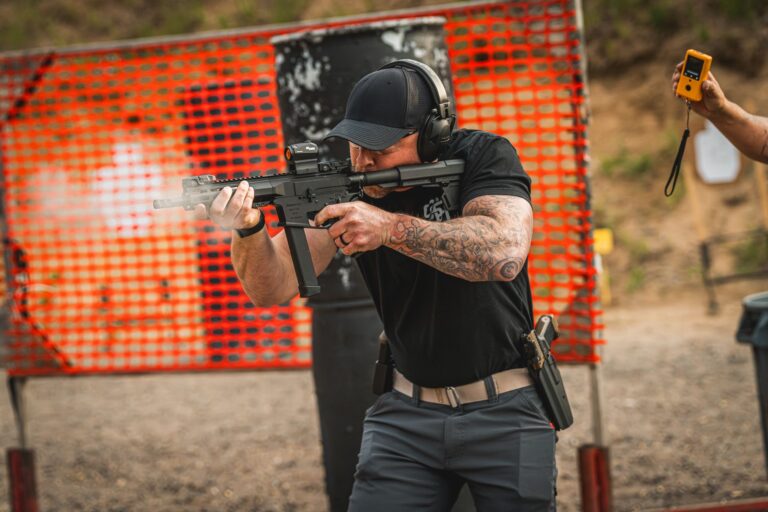
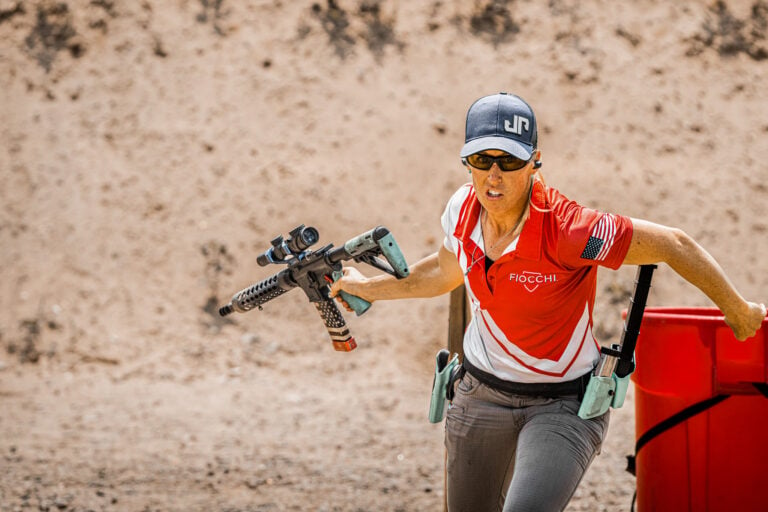
The Tactical Games just dropped their full rundown of what competitors can expect for the 2026 season. Nick Palacios and Chris Gillespie walked through every aggregate, every floater, and a handful of rule changes on the latest podcast. If you’re planning to compete this year, here’s what you need to know.
The Big Changes for 2026
Before we get into the individual stages, there are a few across-the-board changes worth noting.
New Targets. TTG is moving from standard USPSA IPC targets to PCSL targets. These are similar in style—same 18-inch width, same general layout—but slightly shorter. The PCSL targets have an A-zone in the center and a T-zone (head box, formerly K-Zone). For scoring purposes, A and T count the same. You’ll also see C and D zones.
The biggest difference: PCSL uses color-coded targets. Brown targets are for pistol. White targets are for rifle. Red targets with an X are no-shoots. This change makes sense given TTG’s push toward more two-gun stages, which aligns with PCSL’s format.
Standardized Shooting Boxes. All shooting positions now use 3-foot by 3-foot (1-yard) boxes. This standardization helps with consistency across events and makes stage setup more predictable.
More Dynamic Movement. The team specifically called out that last year’s aggregates were too stationary. For 2026, they’ve built in more movement, more position changes, and more emphasis on stage planning. You’ll need to think through your approach, not just execute a prescribed sequence.
Returning Aggregates
Six aggregates return from 2025, mostly unchanged except for the new PCSL targets on paper stages.
Aggregate 1: Pistol Speed Barricade
Single steel plate at 18 yards. You shoot from five different positions on the VTAC barricade. Engage with two rounds, conduct a reload, re-engage. Straightforward speed and barricade work.
Aggregate 2: Rifle Speed Barricade
Same setup as the pistol version, but the steel is at 50 yards. One audible hit from each position, reload, re-engage with one audible hit. These two are the only aggregates requiring barricade shooting.
Aggregate 3: Razzle Dazzle
Four shooting positions with three paper targets. This is a two-gun stage. With rifle, you engage from one far box with two rounds to the head box, move between boxes with two more to the head, reload, then finish from the last position with two to the head. Show clear, sling rifle, move to pistol position, and engage with two to the body from each of three positions.
Aggregate 5: Pistol Speed Plates
Six steel plates, two shooting positions. Engage each plate with two audible hits, move to the second position, reload, then hit each plate once strong-hand only. This one tests your off-hand shooting under time pressure.
Aggregate 6: Rifle Speed Plates
Six plates at the 50-yard line from a single starting position. One round on each plate, reload while moving to prone, then one round on each plate from prone. Tests your positional transitions and prone shooting fundamentals.
New Aggregates for 2026
Here’s where things get interesting. Six new aggregates join the rotation, and they’re significantly more dynamic than what we saw last year.
Aggregate 7: Z Drill
This is a two-gun stage that’s going to test your movement and accuracy under pressure. The setup uses 10 shooting boxes arranged in a specific pattern:
Rifle positions: Two boxes at 50 yards (10 yards apart), one in the middle at 45 yards, and two more at 40 yards—forming a 10-yard square with a center position.
Pistol positions: At 20, 15, and 10 yards following the same Z pattern.
On the start signal, you move to either rear rifle position and engage steel. You can’t advance to the next box until you get the hit—the RO calls them. Work through all five rifle positions in a Z pattern, show clear, sling rifle, then execute the same pattern with pistol.
This one rewards shooters who can maintain accuracy while moving aggressively. Miss a shot and you’re stuck in position.
Aggregate 8: John Adams
TTG’s take on the El Presidente, but with two guns and movement. The setup uses six alternating PCSL targets: white (rifle), brown (pistol), white, brown, etc.
Start with rifle at 15 yards. Two rounds in each white target, reload, two more rounds in each white target—A-zone or T-zone hits required. Clear rifle, move to pistol position at 7 yards, and repeat the El Pres sequence on the brown targets.
Classic drill, TTG twist.
Aggregate 9: Return to Center
Seven steel plates—one center plate marked red, three on each side. This is another two-gun stage.
Starting at 40 yards with rifle, engage the center plate, then work outward. But here’s the catch: after every plate, you return to center. So it’s center, left one, center, left two, center, left three, center, right one, center, right two, center, right three, center. All require one audible hit.
Clear rifle, move to the pistol box, and execute the same pattern. This one will expose anyone who struggles with reacquiring their center reference point under time pressure.
Aggregate 10: LCR (Left Center Right)
Pistol only. Two shooting positions 10 yards apart, each with a barricade (two blue barrels stacked and offset). Start from a center position. On the start signal, draw and move to one shooting position. Engage steel—one audible hit required—then move to the opposite position.
Here’s the twist: loadout is comstock with only 12 rounds. If you miss, your penalty is a shuttle run to the opposite position and back before re-engaging. Start missing and this becomes a cardio stage real fast.
Aggregate 11: Offhand
Two-gun stage, single position, two stacked barrels in front of you. No lateral movement—this one’s all about weapons manipulation and shooting around obstacles.
With rifle: two shots on one side of the barrel, move to the opposite side, two shots. Reload, drop to kneeling, two shots from one side, two from the other. Clear and sling rifle.
Pistol follows the same sequence: two shots per side standing, reload in kneeling, two shots per side kneeling.
This aggregate tests your ability to work around cover efficiently while managing reloads and transitions. The 3×3 box keeps things tight, so muzzle discipline matters.
Aggregate 12: 5.56
Rifle only. The name tells you the loadout: three magazines—five rounds, five rounds, six rounds.
Three shooting positions at 50, 45, and 40 yards. Start at 50 yards in prone, engage steel with five rounds (you’ll run to bolt lock). Get up, reload, move to 45 yards, drop to kneeling with your knee touching the ground and foot touching the stop stick. Five rounds. Bolt lock again. Get up, move to 40 yards, engage standing freestyle with your remaining six rounds.
Scoring is time-based with penalties for misses within the prescribed loadout. You’re balancing speed against accuracy with limited ammunition—no walking shots in here.
Returning Floaters (Physical Work Stages)
Three floaters return unchanged from 2025.
Floater 1: Max C2 Output
90 seconds on your choice of ski erg, rower, bike erg, or strength erg. Some events may have multiple implements available. Max output, simple as that.
Floater 2: Max Sled Drag
90 seconds on a 150-foot field. Weight is dictated by division. Every 10 feet earns you a point. Just keep moving.
Floater 3: Max Rep Weave
Two minutes with a duffel bag. Over the top bar with bag and body, through the middle with bag and body, under the lowest bar with bag and body. Repeat. Tests coordination, flexibility, and the ability to keep moving when you’re gassed.
Modified Floaters
Three floaters from last year got adjustments for 2026.
Floater 4: Max Hand Release Burpees Over Bar
Previously used a plyo box. Now you’re jumping over a yolk bar—40 inches for men, 32 inches for women. The bar adds an athletic component beyond just clearing a static box.
Floater 5: Max Load Over Bar
Last year was max reps with one prescribed bag. This year you’ll have five yolks lined up, each with a different bag ranging from 40 to 200 pounds. Pick your poison. Strategy matters here—do you go heavy for fewer reps or light for volume? The math can get interesting.
Floater 6: 30 Bag Over Bar Reps for Time
Prescribed bag weights by division:
- Men’s Elite: 150 lbs
- Women’s Elite: 100 lbs
- Men’s TAC / Men’s 40+: 125 lbs
- Men’s Intermediate / Men’s 50+ / Men’s 60+: 100 lbs
- Women’s TAC / Women’s 40+: 80 lbs
- Women’s Intermediate / Women’s 50+: 60 lbs
This one sneaks up on you. Nick mentioned his forearms and biceps got smoked around the 5-10 rep range. Your posterior chain lights up too, but the grip fatigue is what gets you as the reps stack up.
Six new floaters join the rotation.
Floater 7: Low Bar Weave
Take the yolk, flip it, and go low. You’re working with about a 16-inch gap underneath and 19 inches on top. Pick up a bag, step over the top, drop the bag, then crawl underneath with bag and body. Two minutes.
There are multiple ways to approach this one, and figuring out your technique matters. Economy of motion is key—where you drop that bag determines how smoothly you can transition.
Floater 8: Burpee Broad Jumps
Prescribed reps by division:
- Elites: 30 reps
- TAC / Men’s 40+ / Women’s TAC / Women’s 40+: 25 reps
- Intermediate / 50+ / 60+: 20 reps
You’re working in a 3×3 box with set distances for each division. The small footprint means you need to land precisely—both feet inside the back of the box. This is harder than it sounds when you’re fatigued.
Floater 9: Burn Pit Shuttle
Remember the burn pit stage from Ohio and Nationals? It’s been condensed into a floater. The crowd wanted it, they got it.
Three bags at different weights. Two drop zones 10 yards apart, two at 20 yards apart, two at 30 yards apart. Start with the lightest bag on the longest carry (30 yards), then middle bag for 20 yards, then heaviest bag for 10 yards. Reverse the order coming back: heavy bag 10 yards, middle bag 20 yards, light bag 30 yards. Finish with a sprint.
“Sprint” is relative after all that carrying, but you get the idea.
Floater 10: Max Jerry Cans and Body Over Bar
Five yolks set up every 15 feet, facing each other and ascending in height. Two jerry cans at your side. On the start signal, throw both cans over, follow with your body, and work through all five yolks. Two minutes. One point for each jerry can over, one point each time your body clears.
Floater 11: Double Duffel Shuffle
50-yard course, two duffel bags. Drag them or bear crawl with your head forward. Points accumulate every 10 feet.
Key caveat: three points of contact required on the ground. No hunch-squatting and dragging. They want to see an actual crawl. This absolutely destroys your shoulders, especially on that first length.
Floater 12: Max Shuttle Run
Just you and your plate carrier on a 25-foot field. Down and back, touching the start/stop stick each time. 90 seconds. Simple, brutal, effective.
Rule Changes for 2026
Beyond the aggregates and floaters, TTG has made some organizational improvements to the rulebook.
Consolidated Match and Stage Procedures. The new rulebook has dedicated sections (6 and 7) covering exactly what’s expected of you as an athlete—from check-in through scoring verification. For newer competitors, this is valuable information. For experienced competitors, it clarifies what’s required when you’re judging other athletes.
Formalized Disqualification Section. DQ conditions now have their own dedicated section for easier reference.
Banned Substances Testing. This was introduced at Nationals last year and is now formalized in the rules. Testing applies to the top five finishers in Men’s and Women’s Elite divisions at Nationals only. Tests can be administered on-site or within seven days post-event, following WADA standards.
Where to Find More Information
TTG has put together comprehensive resources for the 2026 season:
- Full written documentation on their website (tacticalgames.com)
- Explainer videos on YouTube showing SketchUp walkthroughs of each stage setup
- Video demonstrations of the team executing each aggregate and floater
The first regional event at Reveille Peak Ranch kicks off in less than two months. That’s almost enough time to start training the specific skills these new aggregates and floaters will test—particularly the movement patterns in stages like the Z Drill and the conditioning demands of floaters like the Burn Pit Shuttle. Better get to work!
If you’ve got questions or feedback on the new format, reach out to the TTG team. They’re actively soliciting competitor input as they refine the 2026 season.