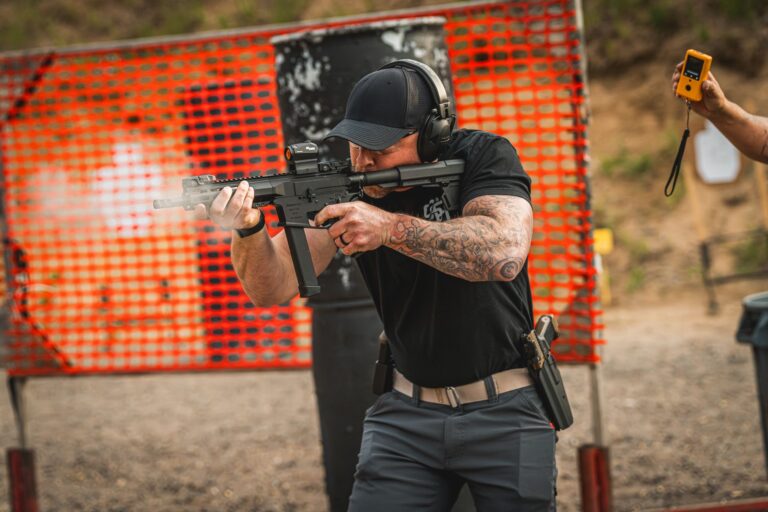
Lauren Kalil’s series with the 2025 Tactical Games National Champions continues with an athlete who took 31st place on one stage, 24th on another, and still walked away with the Men’s Tactical title.
Tory Kirkland had never competed as an individual at Tactical Games Nationals before this year. He’d done plenty of team events—that’s actually how Lauren first met him back in 2023, when he was partnered with Bri. But individual competition? That was new territory.
His strategy wasn’t what you’d expect from a national champion. No talk of refusing to fail, no all-or-nothing mentality. Just one principle: be good enough.
Day one goal: top 10 on every stage. Day two: top five. Day three: top three, trying to win.
He finished 31st on the strength stage. 24th on the run. And he still won the whole thing because he stayed consistent everywhere else. Second place here, third place there, a handful of top-five finishes—never the best on any single stage, but never falling apart either.
The Men’s Tactical division had the tightest point spread of any division at Nationals. Tenth place was at 95.61%. Second place was 98.63%. Tory won with less than two percentage points separating him from the field.
Lauren’s conversation covered his transition from bodybuilding bro to functional athlete, the mysterious woman at a gun store who introduced him to the sport, his time designing guns for a major manufacturer (with 500 free rounds a day), and why he deliberately avoided looking at scores all weekend.
The Mystery Woman at the Gun Store
Tory was working at a gun store near the beach—sales associate, range officer, gun tinker (he won’t call himself a gunsmith). A woman walked in looking for a pistol.
Standard sales interaction: what are you going to do with it?
She mentioned something called “the tactical games.” Tory had no idea what that was. They talked for 30 minutes while he tried to help her find the right rifle and pistol setup. He probably gave her too much information—she left saying she needed to think about it.
Then he got on “the Google.”
A buddy who’d served in the Army was looking over his shoulder. “That looks cool.”
This was around October or November 2021. The closest event was Meridian, Mississippi in February. Tory asked if his buddy wanted to go. He said yes. They signed up for the team division—first year Tactical Games ran team at every event. Only a couple teams showed up, not much competition, but it was a great way to get his feet wet.
He never saw that woman again. Never got her name or contact information. Terrible salesman, apparently. But wherever she is, she’s responsible for introducing the 2025 Men’s Tactical National Champion to the sport.
From Display Model Only to Functional Athlete
Before Tactical Games, Tory trained strictly bodybuilding style. Big muscles, zero cardio. Display Model Only, as Lauren put it—muscles that looked good but couldn’t actually perform.
That first event in Mississippi exposed the problem immediately. The run destroyed him. He had to switch things up.
The transition to CrossFit-style training wasn’t instant. He started in Intermediate divisions for both individual and team events. Moved up to Tactical. Even tried Elite for a year to see where his limits were.
Elite broke him. Too much weight. He’d compete, nurse an injury for a month, barely recover before the next event, never get quality training in between. The sustainability wasn’t there.
So he came back to Tactical, which still has challenging weights but doesn’t leave him broken for weeks afterward. The weights are plenty heavy for him—anyone can outwork him on any given day—but it allows him to train consistently and stay close to top shape year-round.
His ultimate fitness goal isn’t a Tactical Games championship. It’s being able to walk up a couple flights of stairs with grocery bags when he’s 100 years old. Everything else is training for that.
The Numbers Game
Tory is a nerd. Self-admitted. He looks at practice score data constantly—when he’s not competing. He’s analyzed enough results to know that athletes who stay steady through an event usually come out on top.
Occasionally someone like Heppner or Jenay dominates every stage at a regional. If you can do that, great. That’s not where Tory finds success.
His math: if you can finish second on every stage, you might not win any individual stages, but you’ll probably win the event. Third on every stage? Same result. The consistency compounds.
That’s why his goals were tiered by day rather than focused on stage wins. Top 10 across the board on day one just keeps you in the hunt. Top five on day two builds position. Top three on day three, pushing for wins, closes it out.
He’s not chasing stage victories. He’s chasing aggregate consistency.
Not Looking at Scores All Weekend
Here’s where Tory’s strategy gets interesting: he deliberately didn’t check practiscore during competition.
His friend Will—a frequent team partner who knows exactly what competing in Tactical Games feels like—was watching from home. Will would text updates after each day, but never exact standings. Just things like “Hey, you got some ground to make up, bud” or “Turn it on tomorrow.”
Enough to know he was behind. Not enough to know by how much.
Tory’s wife also knows how to work practiscore, which created its own problems. Her texts were more direct: “What is going on? Why do you suck so bad?” Not exactly the supportive message he needed in the moment.
She played collegiate golf and a couple years professionally, so she understands competition weekends—the grind of three and four-day tournaments, coming back from a bad first day, staying focused. She wants him to win. Her approach to encouragement is just… more aggressive.
The point of avoiding scores was mental. If Tory knew exactly where he stood, doubt might creep in. By assuming he had ground to make up regardless of reality, he could stay in attack mode. Every stage on Sunday needed to be all-out effort. That mindset served him better than knowing the precise math.
He did make notes on his hits and misses throughout the weekend—enough to verify that scores were entered correctly at arbitration. Sometimes people fat-finger numbers on the tablets. But he didn’t look at standings until his final stage was complete.
The 31st Place Finish and the Win
Let’s address those two rough stages directly.
Stage one was the run. Tory took 24th. He’s not worried about run stages—damage control, throw an eight, move on. Plus he cramped on that course. Not unexpected given his endurance has always been a weakness relative to the field.
Stage 12 was the StrengthErg. He took 31st. Last place in his division.
And he still won the overall.
Tory thinks he might hold some kind of unofficial record: taking both a last place and finishing first overall in the same event. Not a record anyone wants, but mathematically impressive.
The point spread tells the story. Men’s Tactical was incredibly tight. With 10th place at 95.61% and the top six all above 98%, there wasn’t room for anyone to run away with it. Consistency across all stages—not just the ones you’re good at—determined everything.
Tory didn’t win a single stage. He had seconds, thirds, fourths, fifths, and a handful of top-10 finishes. That was enough. The “good enough” strategy proved out.
When He Knew
Tory started picking up that he was in the hunt Saturday afternoon. Definitely by Sunday morning. People kept coming up to him saying they saw him doing well on the leaderboard.
His response: “I haven’t looked. Don’t tell me. Appreciate it, but don’t tell me.”
He had to rush around telling everyone not to give him exact positions. It was part of his mental strategy. He just needed to know he was in the hunt—that’s all he’d been expecting from the weekend anyway.
The actual confirmation came at arbitration. He had two hits that weren’t counted and went to find Nick to discuss them. But he didn’t want to waste anyone’s time if it wasn’t necessary.
“Hey, I’ve seen the score. I know it’s close. I have two shots I don’t want to bother y’all with if it’s not necessary. Just let me know if second, third, or fourth place come in and they jump me—I’ll bring it up then.”
Palacios went straight into arbitration mode—let’s just get it right. Nick Thayer asked if Tory was sitting in the lead. He was. Nick checked if anyone else had come by to arbitrate. They hadn’t. “You’re good.”
That was the moment. Before the ceremony, before the announcement. Standing in the arbitration classroom knowing nobody was going to jump him.
Already On to Next Year
When Lauren asked if Tory had found the words yet to describe what winning nationals meant to him, his answer was honest: his brain might have skipped over it.
He was excited. Appreciative. But he’s already thinking about 2026. Set goals, accomplish them, set new ones. That’s how his life works.
He acknowledges he should probably work on being more appreciative of accomplishments, on looking back at what he’s achieved. But when he started driving home from Texas, he had his moment, left it there, and shifted focus forward.
His 2026 calendar already has three events: Florida in March, Texas team event in May (hoping Will is fully recovered to compete together), and North Carolina later in the year. Maybe Italy too—his wife immediately started planning a post-competition week in Rome followed by Greek islands.
The rifle is still sitting dirty in its case. Hasn’t been cleaned since Nationals. Hasn’t touched a gun at all. But he’s about to start a new training block. Florida is only a few months away.
The Engineering Brain Behind the Strategy
Tory’s analytical approach makes more sense when you know his background.
He played football, basketball, and baseball in high school. Had the opportunity to play junior college baseball—shortstop originally, then second base after shoulder surgery. But he also wanted to go to Auburn for an engineering degree. He decided he wasn’t going to be a professional baseball player and chose education over athletics.
That’s when the bodybuilding started. No competitive purpose for fitness anymore, just bro lifting with the boys for a decade. Got big, got jacked, couldn’t move well. Still athletic in some sense, but without direction.
His first job out of Auburn was with a battery company. Then he moved to a gun manufacturer as an R&D engineer—research and development, designing firearms.
The job came with a significant perk: access to the test range whenever testing was happening. He could walk in, say he wanted to shoot, and they’d let him put 500 rounds through whatever pistols they were evaluating. Every day he was working, essentially. Two years of that kind of volume with good shooters around him made him a decent shot.
After that job, he decided he didn’t want corporate life and moved to the beach to get into real estate. The gun store job gave him cheaper access to guns and ammo, which let him keep refining skills. Then the mystery woman walked in and the rest is history.
What Competitors Can Take Away
Tory’s championship validates a different approach than the dominant mentality you usually hear from elite athletes:
“Good enough” is a legitimate strategy. You don’t have to win stages to win events. Consistent top-10 or top-5 finishes across all stages beats occasional brilliance paired with occasional disasters.
Know your division. Tory tried Elite, got injured constantly, couldn’t maintain quality training. Dropping to Tactical wasn’t giving up—it was finding where he could compete sustainably. The weights are still challenging, but he can recover and train properly between events.
Protect your mental game. Not looking at scores all weekend kept Tory in attack mode. He assumed he had ground to make up regardless of reality. That assumption drove effort when it mattered most.
Bad stages don’t end weekends. A 31st and a 24th in the same event he won proves that damage control is real. You don’t have to be good at everything—you have to not collapse on your weak stages while capitalizing on your strengths.
Train for the long game. Tory’s ultimate goal is functional fitness at 100 years old. Tactical Games is just a vehicle for staying in shape with purpose. That perspective prevents overtraining, reduces injury risk, and keeps the sport fun rather than grinding.
Team experience translates. Years of team competitions taught Tory how to strategize, how to lean on strengths, how to cover weaknesses. Those lessons informed his individual approach even when he didn’t have a partner to rely on.
Tory Kirkland won his first individual Nationals by being good enough at everything instead of great at anything. The strategy sounds underwhelming until you realize he’s holding the trophy and the guys who won individual stages aren’t.
Sometimes the nerds with spreadsheets figure out what actually works.
Watch the full interview on Lauren Kalil’s YouTube channel, Queen of Hustle. This is part of her series catching up with all the 2025 Tactical Games National Champions. You can follow Lauren on Instagram or visit her website at laurenkalil.com.