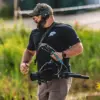
USPSA is the largest competitive pistol sport in the United States, and it’s the one most new shooters stumble into first. There’s a good reason for that. Local clubs run matches almost every weekend, the gear barrier is lower than most people expect, and the format rewards the thing every gun owner already wants to be: fast and accurate with a handgun.
I started competing in multigun back in 2014, and USPSA was the discipline that sharpened my pistol shooting faster than anything else. The stages force you to move, think, and shoot under time pressure in ways that standing on a static range never will. Whether you’re considering your first match or you’ve been shooting local club events and want to understand the bigger picture, this guide covers everything: divisions, scoring, gear, classification, and what happens when you show up.
If you want to add rifle and shotgun to the mix, check out our complete guide to 3-Gun competition.
What Is USPSA?
USPSA is the U.S. region of IPSC (International Practical Shooting Confederation), so if you see both acronyms online, they’re related. USPSA governs domestic competition under IPSC’s international framework. The organization was founded in 1984, but what matters to you right now isn’t the history. It’s what makes this sport different from everything else you can do with a pistol.
Unlike static bullseye shooting, USPSA stages require movement. You’re drawing from a holster, engaging targets from multiple positions, navigating around walls and barricades, and making split-second decisions about target priority, all while a timer records every tenth of a second. Unlike IDPA, which adds procedural constraints meant to simulate self-defense scenarios, USPSA lets you solve each stage however you want. The fastest, most accurate solution wins. Period.
USPSA hit an all-time membership record of more than 42,000 competitors in 2025, with over 500 affiliated clubs across the country running regular matches. Most charge $20-$40 for a local match, run 4-6 stages, and take about 3-4 hours to complete. Annual USPSA membership runs $65. You can find matches through PractiScore or on our major match calendar.
How Does USPSA Scoring Work?
Scoring is where new shooters get confused, and it’s where USPSA gets interesting. The system is designed so that speed and accuracy both matter, but the balance between them isn’t always obvious. Understanding hit factor changes how you approach every single stage.
Hit Factor: The Math That Determines Who Wins
Hit factor is your total points divided by your stage time. Higher hit factor wins.
Every scored target has four zones. A-zone hits earn 5 points. C-zone hits earn 3 points (minor power factor) or 4 points (major power factor). D-zone hits earn 1 point (minor) or 2 points (major). Misses earn 0 points and add a 10-point penalty.
Here’s a concrete example that shows why this matters.
Shooter A fires 12 shots in 8.5 seconds. Hits 10 Alphas and 2 Charlies. At minor power factor, that’s (10 x 5) + (2 x 3) = 56 points. Hit factor: 56 / 8.5 = 6.59.
Shooter B fires 12 shots in 6.2 seconds. Hits 8 Alphas and 4 Charlies. That’s (8 x 5) + (4 x 3) = 52 points. Hit factor: 52 / 6.2 = 8.39.
Shooter B wins the stage despite fewer Alphas. The 2.3-second speed advantage more than offset losing 4 points. This is the core tension of USPSA. You’re constantly balancing accuracy against speed, and the math determines where that balance point falls.
You can run your own numbers with our hit factor calculator. For a deeper dive into how the scoring system shapes strategy, read our full breakdown of hit factor scoring in shooting sports.
Power Factor: Major vs. Minor
Power factor determines your scoring advantage on imperfect hits. The formula is simple: bullet weight (in grains) x muzzle velocity (in feet per second) / 1,000.
Minor power factor requires a minimum of 125. A standard 124-grain 9mm load at 1,050 fps produces a power factor of 130, comfortably minor. Most Production, Carry Optics, and Limited Optics shooters run minor.
Major power factor requires a minimum of 165. A typical .40 S&W load (180-grain bullet at 920 fps) gives you a power factor of 165.6. Major is primarily used in Limited and Open divisions, where the C-zone and D-zone scoring advantage rewards the heavier-recoiling caliber.
The strategic trade-off is there. Shooting major means your C-zone hits score 4 instead of 3, and D-zone hits score 2 instead of 1. But major-caliber guns kick harder, which slows your split times. Whether that scoring advantage outweighs the speed penalty depends on your accuracy under speed, and that’s a question only your match results can answer.
Calculate your load’s power factor with our power factor calculator. For a complete breakdown of the strategy behind major vs. minor, see our power factor explainer. And if you’re loading your own ammo or verifying factory loads, our chronograph data guide walks through proper load testing.
Penalties That Cost You Stages
Know these before your first match:
- Miss: 10-point penalty per miss. You score 0 for the target AND lose 10 points.
- No-shoot hit: 10-point penalty per hit on a non-threat target (the ones with their hands up or marked with an X).
- Procedural penalty: 10 points for breaking stage procedures (shooting targets out of order when specified, not following mandatory reload instructions, etc.).
- Failure to engage: 10-point penalty per target you skip entirely.
- Failure to do right (FTDR): The catch-all penalty for breaking stage rules in ways not covered above. The range officer will explain what happened.
At a 6.0 hit factor, a single miss costs you roughly the equivalent of 1.7 seconds. Two misses on a 12-second stage can drop you from the top of a squad to the middle. Penalties add up faster than most new shooters expect.
One recent rule change to know: as of the 2025 rulebook, stage designers can now stipulate strong-hand-only or weak-hand-only shooting on short courses (8 rounds max for weak-hand stages). You won’t see this at every match, but it’s worth practicing both hands before you encounter it on the clock.
What Are the USPSA Divisions?
Divisions are how USPSA keeps competition fair. Each division defines what equipment you can use (optics, magazine capacity, modifications, caliber) and you compete only against others in the same division. Picking the right division is the first real decision you’ll make as a new competitor.
| Division | Optics | Magazine Limit | Power Factor | Typical Entry Cost | Best For |
|---|---|---|---|---|---|
| Production | Iron sights only | 10 rounds* | Minor (125) | $500 — $800 | New competitors with existing pistol |
| Carry Optics Fastest Growing | Slide-mounted red dot | 141.25mm | Minor (125) | $800 — $1,500 | New competitors, most popular division |
| Limited Optics | Slide-mounted red dot | 141.25mm | Minor (125) | $1,500 — $3,500 | SAO pistol shooters, CO-to-Limited bridge |
| Limited | Iron sights only | 141.25mm | Major (165) | $1,500 — $4,000 | Experienced competitors, serious investment |
| Open | Yes (any mount, comp allowed) | 171.25mm | Major (165) | $3,000 — $6,000+ | Maximum performance, highest cost |
| Single Stack | Iron sights only | Single-stack mags | Major (165) | $1,200 — $3,000 | 1911 enthusiasts |
| PCC | Yes | Unlimited | Minor (125) | $800 — $2,000 | Rifle-platform crossover, accessibility |
Note: Production magazine limit and specific division rules are subject to USPSA updates. Verify current rules at USPSA.org before investing in division-specific gear.
Production
Production is where the most new competitors start, and where some of the best shooters in the sport still compete. The rules are straightforward: iron sights only, approved pistol list, 10-round magazine limit (at certain match levels), and limited modifications. Your gun has to look and function close to factory spec.
Popular Production pistols include the CZ Shadow 2 ($1,100-$1,300), Walther Q5 Match ($700-$850), Glock 34 ($550-$650), Sig P320 X-Five ($700-$900), and Beretta 92X Performance ($1,200-$1,400). If you already own a full-size 9mm from a major manufacturer, there’s a decent chance it’s on the approved list and you can show up this weekend. For a deeper look at the best options, see our complete Production pistol breakdown.
The 10-round limit makes stage planning a big deal. On a 32-round stage, you’re reloading at least three times while Carry Optics shooters might reload once. That forces you to think about when and where you reload, a skill that makes you a better competitor no matter what division you end up in. For a full rules breakdown and gear guide, check out our USPSA Production Division guide.
Carry Optics
Carry Optics is the fastest-growing division in USPSA, and it’s where the sport is heading. The equipment restrictions are similar to Production, but you can mount a red dot on your slide and load magazines to 141.25mm overall length, which typically means 20-23 rounds in 9mm depending on the platform.
This is the division I’d point most new competitors toward today. Red dots are easier to learn than iron sights for the majority of shooters. The target acquisition is faster, the feedback loop is more intuitive, and the gear overlaps with what many people already run on carry and home defense guns. A Glock 34 MOS with a Holosun 507C and a few OEM 17-round magazines is a competitive Carry Optics setup for under $900 total.
The deeper magazine capacity compared to Production also means fewer mandatory reloads, which lets you focus on shooting and movement rather than magazine management during your first few matches. For a complete breakdown of Carry Optics rules, gear, and strategy, see our Carry Optics Division guide. If you’re shopping for an optic, our best red dots for Carry Optics covers what’s worth the money.
For more context on how optics divisions are reshaping the sport, check out The Rise of the Modified Optics Division.
Limited Optics
Limited Optics is the newest official USPSA division, moving from provisional status to full recognition in 2025. It allows single-action-only (SAO) pistols with slide-mounted red dots. The Staccato/STI 2011 with a dot is the prototypical Limited Optics gun.
The distinction from Carry Optics: Limited Optics allows SAO triggers and 2011-pattern pistols that aren’t legal in CO. If you already own a Staccato with a dot and want to compete against other shooters running the same type of platform, Limited Optics is your division. Minor power factor scoring keeps the recoil manageable and the ammo affordable.
Limited Optics is growing fast, driven by the same wave of red dot adoption that built Carry Optics into the largest division. If you’re shooting a 2011-style pistol and don’t want to give up your optic to shoot Limited, this is the division USPSA built for you.
Limited
Limited is the step up in both investment and intensity. Double-stack pistols, 141.25mm magazine length, iron sights only, and, critically, major power factor is available. Most Limited shooters run .40 S&W or 10mm to hit that 165 power factor threshold and get the C-zone and D-zone scoring advantage.
The dominant platforms are the Staccato/STI 2011 ($2,000-$4,000), CZ Tactical Sport series ($1,200-$1,500), and Tanfoglio Stock II/III ($900-$1,400). Ammo costs are higher with .40 S&W, and the recoil demands more refined fundamentals. This is a division for shooters who’ve been competing for a while and want a more demanding equipment class. Our USPSA Limited Division guide covers the rules, gear, and the strategic reality of shooting major power factor with irons.
Open
Open is the Formula 1 of USPSA. No real restrictions. Frame-mounted red dots, barrel compensators, magwell funnels, extended magazines to 171.25mm. These are purpose-built race guns designed to do one thing: shoot the fastest possible hit factors.
Competitive Open guns start around $3,000 and fully built setups commonly run $5,000-$7,000+. Add in the cost of major power factor 9mm loads (or .38 Super), and you’re looking at a significant ongoing investment. Open shooters post hit factors that other divisions can’t touch. But this isn’t where you start. I’ve seen exactly one new competitor intentionally show up to their first match in Open. He had a great time, but he spent more on that gun than most people spend on their first three competition seasons combined. Our Open Division guide has the full breakdown if you’re ready for that level. Our C-MORE RTS3 V2 coverage shows where frame-mounted dot pricing sits.
Single Stack and PCC
Single Stack is 1911-based competition with a dedicated following. If you love the 1911 platform and want to compete with a single-stack gun against other single-stack shooters, this is your division. The community is smaller but passionate, and watching a good Single Stack shooter work a stage with 8-round magazines is a masterclass in stage planning. See our Single Stack Division guide for the full rules and gear breakdown.
PCC (Pistol Caliber Carbine) allows rifle-platform firearms in pistol calibers. AR-9s, Ruger PC Carbines, CZ Scorpions. If it feeds pistol ammo through a shouldered platform, it probably qualifies. PCC has grown rapidly because it’s accessible, fun, and the recoil management of a shouldered gun makes it the easiest division to shoot fast in. It’s a great entry point for rifle shooters who want to try competitive pistol-caliber events. Our PCC Division guide covers the rules and setup options.
What Do You Need for Your First USPSA Match?
You need less than you think. The gear anxiety that keeps people from showing up to their first match is almost always overblown. Here’s what you need to know.
Essential Gear
- Handgun: Any division-legal pistol. If you own a full-size 9mm, you likely already have this covered.
- Holster: Must be an outside-the-waistband (OWB) belt-mounted holster. No concealment holsters, no shoulder rigs, no SERPA-style holsters (most clubs ban them). A basic Blade-Tech or Safariland OWB holster runs $40-$80. Our competition holster guide covers the best options by division.
- Belt: A rigid gun belt that won’t sag under the weight of your holster and magazine pouches. A dedicated inner/outer competition belt setup costs $60-$120, but a sturdy leather or reinforced nylon belt works for your first few matches. For a detailed setup walkthrough, see our USPSA belt setup guide.
- Magazine pouches: At least 2, mounted on your belt. Basic Kydex pouches cost $15-$25 each.
- At least 3 magazines: You’ll need to load at least twice per stage in most divisions. More magazines means less time spent reloading between stages.
- Ammunition: Bring at least 150 rounds for a typical 4-5 stage local match. I’d bring 200 to be safe.
- Eye and ear protection: Non-negotiable. Bring what you have.
Total cost beyond the gun itself: $100-$250 for a functional first-match setup.
Helpful But Not Required for Day One
- A shot timer for practice (but the match provides one)
- Extra magazines (5+ total is ideal for smooth squad rotation)
- A magazine loader (your thumbs will thank you after loading 200 rounds of 9mm)
- A range bag organized for quick access
- A small notebook for recording stage plans and observations
What You Don’t Need Yet
Don’t buy a race gun, a $300 competition holster rig, or custom-tuned magazines before your first match. I’ve watched new shooters show up with $4,000 worth of Open division gear and zero matches under their belt. They spent months researching equipment instead of weeks learning the sport.
Shoot 3-5 local matches with what you have. Figure out which division you enjoy. Talk to other competitors about what they run and why. Then invest in division-specific gear with match experience informing your decisions.
What to Expect at Your First USPSA Match
Match anxiety is the number one barrier to entry for new competitors. Here’s exactly what happens so you can stop worrying and start planning.
Arrive early. Most local matches start around 8:00-9:00 AM. Show up 30-45 minutes before the scheduled start. Find the registration table, sign in, pay your match fee, and get your squad assignment. Tell the match director it’s your first match. They’ll make sure you’re on a squad with experienced shooters who’ll help you through the process.
Safety briefing. Before shooting starts, the match director runs a safety briefing covering the range rules, cold range procedures (your gun stays unloaded and holstered until you’re on the firing line), and any match-specific notes. Pay attention. Ask questions if anything is unclear.
Walk-throughs. Your squad walks each stage together before anyone shoots it. This is where you study the target layout, plan your movement, figure out your reload points, and ask the range officer about stage procedures. Watch how experienced shooters plan their stage. You’ll learn more in these five minutes than in hours of YouTube. For a deeper guide on how to read and plan stages, see our stage planning for USPSA article.
The shooting rotation. Squads typically rotate through a shoot/paste/reset cycle. When it’s your turn, the range officer gives you the commands: “Make ready” (load, holster, take your position), “Are you ready?” (nod or say yes), “Standby” (the beep is coming), then the start signal. After you finish, the RO calls “If finished, unload and show clear,” then “Hammer down, holster.” Follow these commands exactly.
When you screw up (and you will), it’s fine. Everyone does on their first match. I forgot to engage an entire target array on my second stage ever. The RO called a failure to engage, I got a bunch of penalties, and the world kept spinning. Nobody judged me for it. The experienced shooters on my squad laughed, told me they’d done the same thing, and helped me understand what happened.
After the match, results are typically posted to PractiScore within a day or two. Don’t obsess over your placement. Look at your hit factor on each stage and compare it to the shooters a few spots above you. That’s your roadmap for what to work on.
How USPSA Classification Works
USPSA uses a classification system that ranks shooters from U (Unclassified) through Grand Master. Understanding the system helps you track your progress and set realistic goals.
The classes, from lowest to highest:
- U: Unclassified (fewer than 4 classifier scores on record)
- D: 2-39.9% of High Hit Factor
- C: 40-59.9%
- B: 60-74.9%
- A: 75-84.9%
- M (Master): 85-94.9%
- GM (Grand Master): 95-110%
How it works: Certain standardized stages (called classifiers) are sprinkled into regular matches. These stages have known par times and have been shot by thousands of competitors, so your performance can be compared to a national baseline. Your classification is based on your best 4 of your most recent 6 classifier scores.
2025 Classification System Changes
USPSA overhauled the classification system in April 2025. If you were classified before the update, here’s what changed:
- B, C, and D flags removed. Previously, classifier scores more than 5% below your current classification were flagged and excluded. Now all scores count. This rewards consistency. You can’t protect your classification by throwing out bad runs.
- Same-Day Average (SDA). If you shoot the same classifier multiple times in one day (which happens at classifier-heavy matches), those attempts are averaged into a single score instead of each counting independently.
- Most Recent Override (MRO). If you shoot the same classifier on different days, only the most recent day’s SDA is used. This prevents older attempts of the same stage from anchoring your classification when you’ve improved (or regressed).
- Standardized High Hit Factors (HHFs). USPSA recalculated the reference scores for all classifiers using a data-driven statistical model, replacing the old system where HHFs could drift based on submission patterns. The result is more consistent, objective benchmarks across divisions.
- 23- and 24-series classifiers reinstated. Older classifiers were recalibrated with updated HHFs, and the new 25-series classifiers were approved.
The net effect for most shooters: a slight increase in classification percentage, and a system that rewards consistent performance over the old “hero or zero” approach where a single great run could carry a mediocre average.
Realistic timelines: Most active shooters who practice regularly and compete 2-3 times per month reach C class within 6-12 months and B class within 1-2 years. A class is where progress slows significantly for most people. The jump from B to A often takes longer than D to B. Master and Grand Master represent the top tier of the sport, and reaching either typically requires years of dedicated training. For strategies on improving your classification, see our USPSA classifier strategies guide.
Match Levels: From Local Club to Nationals
USPSA matches run at three levels, and the pathway from your first local match to a National Championship is more straightforward than you’d expect.
Level I, Club Matches. These are your bread and butter. 4-6 stages, 100-200 rounds, 3-4 hours, $20-$40 entry fee. Most clubs run them weekly or biweekly. This is where you learn the sport, build skills, and get your classifier scores. The atmosphere is casual and the competition is friendly. One recent change: as of the 2025 rulebook, Level I stage designers can require competitors to stay within fault lines on a stage, which wasn’t enforceable before. Show up, shoot, learn, repeat.
Level II, Section and Area Matches. Larger matches with more stages (8-12), higher round counts (200-350), and a full day of competition. Entry fees run $75-$150. These attract stronger fields and often feature more creative, challenging stage designs. Area Championships are the marquee Level II events. There are eight Area matches across the country, and winning one is a significant accomplishment.
Level III, National Championships. Multi-day matches with 12-16 stages, 400+ rounds, and the best shooters in the country. USPSA runs separate Nationals for each division or group of divisions. Entry fees range from $200-$350, and you’ll need travel, lodging, and a significant ammo budget on top of that. You typically need a current classification to register, but there’s no qualification score required. If you have a classification and a slot opens, you can sign up.
The jump from local club to Nationals is a matter of registration and commitment. You don’t need to win your area to compete nationally. You don’t need a sponsor. You need a classification, the entry fee, and enough ammo to finish the match. I’d recommend shooting at least a full season of Level I and a couple Level II matches before entering a National Championship, but nobody is stopping you from going sooner.
Check our major match calendar for upcoming Level II and III events, and read our 2025 USPSA Multigun Nationals recap for a look at what the top level of competition looks like.
USPSA vs. Other Shooting Sports
If you’re deciding between competitive shooting formats, here’s how USPSA compares to the other major options.
| Feature | USPSA | IDPA | Steel Challenge |
|---|---|---|---|
| Scoring | Hit factor (points / time) | Time plus penalties | Fastest raw time |
| Stage Design | Open, creative, varied | Scenario-based, procedural | 8 standardized stages |
| Movement | Extensive, shooter’s choice | Prescribed, cover required | Minimal (standing) |
| Gear Restrictions | Varies by division | Carry-style equipment | Minimal |
| Round Count (local) | 100 — 200 | 80 — 120 | 100 — 150 |
| Best For | Shooters who want freedom in problem-solving | Shooters who prefer structured scenarios | Shooters who want pure speed |
USPSA vs. IDPA: IDPA adds concealment garment requirements, mandatory use of cover, and procedural rules designed to simulate defensive scenarios. USPSA gives you an open playing field. Solve the stage however you want, and the hit factor determines who did it best. Both sports develop solid pistol fundamentals, but USPSA rewards creative problem-solving while IDPA rewards disciplined tactical habits. Many competitors shoot both.
USPSA vs. Steel Challenge: Steel Challenge is pure speed on standardized steel stages. No paper targets, no movement, no stage planning. Just draw and hit steel as fast as possible. It’s the most accessible entry point into competitive shooting (you can shoot it with a .22), and transitions transfer directly to USPSA. If you want to improve your draw and transitions, Steel Challenge is outstanding practice.
USPSA vs. 3-Gun: USPSA at the local level is pistol-only. 3-Gun adds rifle and shotgun to the equation. Here’s our complete breakdown of multigun competition. Many competitors start in USPSA pistol and later expand to multigun. The scoring systems overlap (USPSA Multigun uses hit factor), and pistol skills transfer directly. For a look at how time-plus scoring differs from hit factor in multigun contexts, we’ve covered that separately.
FAQ: Common Questions About USPSA
How much does it cost to shoot a USPSA match?
A local club match typically costs $20–$40 for the entry fee plus $30–$60 in ammunition (150–200 rounds of 9mm at current prices). Your total out-of-pocket for a morning of competition is roughly $50–$100. Level II matches run $75–$150 and National Championships $200–$350, not including travel and lodging.
Can I shoot USPSA with a stock Glock?
Yes. A factory Glock 17 or Glock 34 is legal in Production division with zero modifications. Add a slide-mounted red dot and it’s legal in Carry Optics. Some of the best shooters in the country built their skills on stock Glocks. Don’t let equipment hold you back from showing up.
What is the difference between USPSA and IDPA?
USPSA uses hit factor scoring (points divided by time) and gives you freedom to solve stages however you want. IDPA uses time-plus scoring (raw time plus penalties) and adds procedural rules like mandatory use of cover and concealment garments. USPSA rewards speed and creative problem-solving; IDPA rewards disciplined defensive habits. Both build strong pistol fundamentals.
How do I find USPSA matches near me?
The two best resources are PractiScore.com (search by location and date) and the USPSA club finder on USPSA.org. Our major match calendar tracks larger Level II and Level III events. Most clubs also post match schedules on their Facebook pages. Search for “[your area] USPSA” and you’ll usually find an active group.
What is a good hit factor in USPSA?
It depends entirely on stage difficulty. On a close, fast field course, B-class shooters in Carry Optics typically post hit factors in the 5.0–7.0 range. A-class and Master shooters push 7.0–9.0. Grand Masters consistently break 9.0+ on the same stages. On long-range or complex stages with lots of hard cover, hit factors across the board drop to 3.0–5.0. Use our hit factor calculator to compare your scores.
How many rounds do I need for a USPSA match?
A typical local match with 4–6 stages requires 100–200 rounds. Bring at least 150 and you’ll almost certainly have enough. Level II matches with 8–12 stages can require 250–350 rounds. Check the match description on PractiScore for the estimated round count. Most match directors post it in advance.
Do I need to be classified to shoot USPSA?
No. You can shoot any local or Level II match as an Unclassified (U) shooter. You’ll earn classifier scores as you shoot matches that include classifier stages, and your classification will be assigned automatically once you have enough scores on record. A current classification is typically only required for National Championship registration.
What is the most popular USPSA division?
Carry Optics is the most popular and fastest-growing division in USPSA. At most local matches, Carry Optics has the largest number of entries, followed by Production and Limited. The growth tracks directly with the mainstream adoption of slide-mounted red dots. As more people put dots on their everyday pistols, more of them show up to compete with what they already own.
USPSA is the most accessible competitive shooting sport in America for a reason. The matches are everywhere, the gear barrier is low, and the format is pure. Solve the stage, beat the clock, and let the math decide who was fastest and most accurate. Everything else is details, and you’ve now got the details.
Your next step is simple: find a local match on PractiScore, bring the gear you have, and tell the match director it’s your first time. You’ll be slower than everyone else. You’ll forget targets. You’ll fumble a reload. And somewhere around stage three, you’ll understand why people keep coming back every weekend.
I’ll see you at the range.