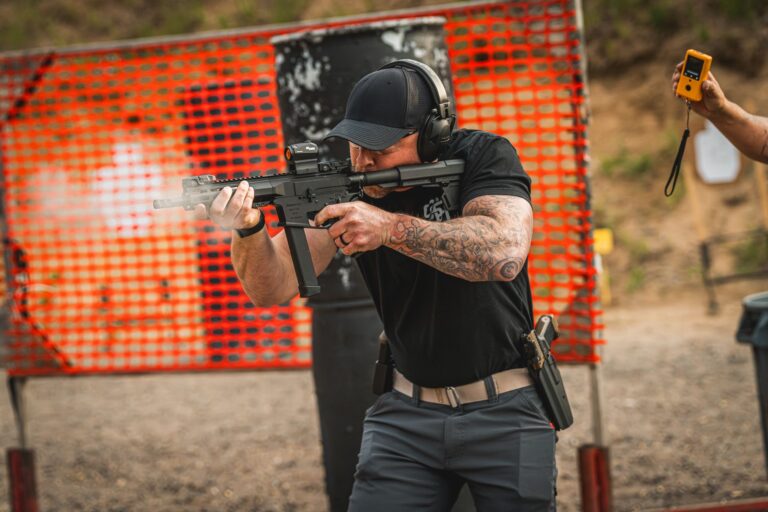
Lauren Kalil’s series with the 2025 Tactical Games National Champions continues with the man who pushed for the 60+ division’s creation—and then won it after literally dying on the firing line two years earlier.
Jeff Craddock’s heart stopped working properly on September 3rd, 2023, at 3:12 PM. He was in Las Vegas, day two of a Tactical Games regional, knelt down to shoot from a barricade, and collapsed face-first into the dirt. He never moved his arms to break the fall.
For eleven minutes, he was dead. No blood flow. Heart quivering at 400-500 beats per minute—which is the same as not beating at all. The only reason he’s here to tell the story is because Rich Hill, a 30-year firefighter, happened to be the athlete RO in the lane next to him and recognized immediately what was happening.
V-tach. Ventricular tachycardia. Between 85 and 99 percent of people who experience it die. CPR alone can’t fix it. You need an AED—electric shock—or you’re gone.
Two years later, Jeff stood on top of the podium as the first-ever Men’s 60+ National Champion. He has an implanted defibrillator now. He still gets nervous before every competition. He wouldn’t have it any other way.
Lauren’s conversation covered Jeff’s transition from 25 years of bike racing to tactical games, the love-hate relationship with a sport that kept injuring him, his ridiculous home range setup (including a thousand-yard shooting lane from his back porch), and why he spent years bending Nick’s ear about creating an age division that would give older competitors a reason to keep showing up.
The Trailblazer Who Made 60+ Happen
Jeff didn’t just compete in the first 60+ division at nationals. He’s the reason it exists.
He started working on Nick about it when he was 58, turning 59. The pitch was simple: you have to give older guys a place to go, or they’re going home.
“They’re not getting younger, but we are getting older,” Jeff told Lauren. “I can’t compete against the 50-year-olds anymore.”
By mid-60s, he argued, the physical gap is insurmountable. Not because older competitors don’t train or don’t care—but because biology has limits. From 40 to 50 is a big jump. From 50 to 60 is light years. Competitive people do competitive things, but they don’t want to show up knowing they have zero chance regardless of preparation.
Jeff had watched guys leave the sport because there was nowhere for them. Athletes he’d seen competing three, four, five times a year just disappeared. Some went to other shooting sports where the physical demands were lower and their skills could still translate.
He kept talking to other competitors, finding out who else was aging into 60 and who was close behind. The demand was there—it just needed someone to push for the division.
Last year at nationals, Jeff finished eighth in the 50+ division at age 59. He was actually happy with that result because everyone who beat him should have beaten him from a physical standpoint. The oldest guy ahead of him was 54. The pattern was clear: once you got into the upper 50s and beyond, the finishes clustered together. Age mattered.
This year, 15 competitors showed up for 60+. Not just one squad—actual depth. The division Jeff lobbied for became real, and it was competitive.
The Farm With Everything
Jeff has one of the most absurd home training setups you’ll hear about in tactical games.
A 40-by-75 foot sand berm range with lights. Everything you’d need for Steel Challenge. A Texas Star. Dueling tree. Plate rack. A thousand-yard shooting lane where targets run all the way out—accessible from a table seven yards from his back porch door.
He’s embarrassed to admit he doesn’t really use most of it.
“I shoot in my barn,” he told Lauren. “It’s like 30 yards from the house. It’s much easier.”
The barn has a heated workout gym. His wife turns on the heater for him in the mornings when she goes out to feed animals. Two barns total, with a third being built. A hundred-acre swamp for duck hunting. A 150-acre lake. Deer and turkey on the property.
He’s basically the Masters version of Jacob Heppner’s setup—everything you could possibly want for training, right there at home. The difference is Jeff admits the convenience makes him lazy about using it. When you can train anytime, you wait for perfect weather. When it’s 68 degrees, sunny, no wind, he’ll set up a stage. Otherwise, the barn is right there.
For 2026, that changes. His two worst finishes at nationals—seventh and eighth—were both on two-gun stages. The data is clear about what needs work. He’s committed to cleaning up the range, getting it organized, and actually using it.
From Bike Racing to Peeing on Truck Tires
Jeff was a bike racer for over 25 years. The kind who put in 15-16 hours a week on the bike to stay competitive. That much time in the same position takes a toll—hip issues, shoulder issues, a body optimized for one specific movement pattern.
He needed cross-training. Somehow he stumbled onto tactical games and found an event in West Virginia about five or six weeks out. He called a buddy.
“This can’t be all that hard. You’re a physical phenom and I’m a shooter, so let’s go do the team thing.”
They were a terrible team. Jeff could shoot but couldn’t keep up physically. His buddy was the opposite. So they both dropped to intermediate and competed individually.
Jeff finished seventh. His buddy finished fourth. They got in the truck and didn’t stay for the ceremony.
Somewhere on the drive home, they stopped at a Hardee’s. Then a rest area. Jeff couldn’t walk to the bathroom. His legs wouldn’t work. He ended up leaning on the front of the truck in the dark, seriously considering whether he could make it to the building or if he was going to pee on the tire right there.
He peed on the tire.
The West Virginia course had destroyed him. Five-mile run with hills so steep you were on hands and knees, dragging yourself up 45-degree clay slopes. A zercher carry at 160 pounds on an axle bar that he couldn’t clean—so he had to break it all down and carry every piece individually. His preparation had been running a mile, maybe twice a week.
He spent the whole weekend getting tortured. His immediate thought: when’s the next one?
The Love-Hate Relationship
Jeff’s tactical games journey has been defined by injuries.
His second event was Phoenix, beginning of October. During the time between West Virginia and Arizona, he ran almost every day. Showed up to Phoenix ready—and the run was only 1.3 miles. All that preparation and the event didn’t even test what he’d trained.
It was still brutally hard. And he pulled his hamstring. The whole thing went purple, started swelling. He went from second place after day one to fourth by the end, then went home thinking he was done with this sport.
Torn hamstrings take six months to heal. Who needs this?
Then the next year’s schedule came out and he was signing up for Mississippi in March.
That pattern repeated. Every event through Florida of this year, he came out injured somehow. It took years just to get his body into the condition it needed to be in—not the shape, but the condition. Bike racing builds all quads, no posterior chain. Glutes disappear. Hamstrings go away. The body had to be rebuilt for different demands.
His philosophy: he’d rather be injured at 60, limping half the time, than sitting on the couch weighing an extra 75 pounds. That’s not what he’s interested in. He wants to stay as fit as possible, as young as possible, doing challenging things.
The tactical games requires everything-shape. You can’t just ride a bike four hours a few times a week and be good at it. Every time he shows up, they torture him with something different. That’s the point. That’s what keeps him coming back.
September 3rd, 2023, at 3:12 PM
Day two of the Las Vegas regional. Jeff was a tenth of a percentage point off the podium going into the final stages—his kind of stages. Heavy carries, rope climbs, things that gas everyone else. His cardio advantage from bike racing let him get to the shooting line, take three or four breaths, drop his heart rate 30 beats, and execute while others were still recovering.
Mike Tracino was in lane one. Jeff was in lane three. Rich Hill was the athlete RO in lane two. A bunch of other guys were waiting for the next group—Matt Ventress, Bob Porzy, others.
The stage started a little after 3:00. Pick up sandbags. Run. Go over the wall. Climb the rope.
Jeff was using Tracino to pace himself up the rope—the guy’s small, climbs like a monkey. Keep up with him and you’re golden. They dropped down. Threw sandbags under. Climbed the wall. Picked up sandbags. Ran down. Picked up rifles.
The barricade had three slots and a triangle up top. Jeff was starting at the bottom. He got down to his knees.
That’s the last thing he remembers.
Rich Hill saw Jeff go down. His arms never moved from where they were. He just went face-first into the dirt. Rich knew immediately—that’s not someone passing out. That’s someone who’s out.
Ceasefire was called. Rich rushed over, flipped Jeff onto his back, and recognized what was happening. V-tach. Jeff’s heart was beating at 400-500 beats per minute, which meant it was just quivering—moving, but not pumping blood. Functionally identical to cardiac arrest.
The problem with V-tach is that CPR alone can’t fix it. You can beat on someone’s chest forever and it won’t correct the electrical signal loop causing the heart to malfunction. You need an AED. You need electric shock.
There was no AED at that end of the Vegas facility. Someone had one in their car at the front. People took off running to get it.
Meanwhile, all stages stopped. Jeff’s wife was competing a couple ranges over, about to start a stage when the ceasefire was called. Megan Kennedy and other women got to her first, kept her informed but separate. Let the people working on Jeff do their job without adding chaos.
Matt Ventress and Bob Porzy joined Rich Hill. Someone was in charge—Rich, the 30-year firefighter who knew exactly what this was. Two people rotated CPR, one minute on, one minute off. Both combat veterans who just decided: here’s what we’re doing, here’s how we’re doing it. Done.
Eleven minutes.
The AED arrived. First shock—Jeff’s eyes opened. Then they closed. The device prepared for the second shock. Hit him again. Same sequence.
Then he was awake. Joking around. Asking the helicopter pilot if they could drop him at the helipad on top of the Bellagio since that’s where he was staying. Great Uber service.
At the hospital, staff kept coming in to touch him and say they were going to go buy lottery tickets. Nobody shows up alive from eleven minutes of V-tach. And the ones who do have brain damage from oxygen deprivation. Jeff was cracking jokes.
The CPR had been done correctly. Blood never stopped flowing to his brain. Rich Hill ran the whole operation, respirating Jeff, keeping timing, overseeing everything while others did chest compressions.
The Worst Best Thing
Jeff calls it the worst best thing that could ever happen.
The worst part is obvious. The best part is harder to explain.
“You change,” he told Lauren. “Things that used to not be so important become more important. Family and friends mean a lot more to me now.”
He wasn’t on a bad track before. Wasn’t doing anything wrong. But priorities shift when you’ve been dead for eleven minutes and a specific group of people are the only reason you’re not still dead.
The stars aligned in an absurd way. Rich Hill happened to be the athlete RO in the adjacent lane. Bob Porzy—Dr. Bob—was right there. Matt Ventress was waiting for the next group. Combat veterans who knew how to stay calm, make a plan, and execute it. A cardiologist happened to have an AED in his car.
If it had happened at Jeff’s farm, on his climbing wall 75 yards from the house, even if his wife saw him go down immediately—what are the odds she could maintain CPR long enough for an ambulance to reach rural Virginia and do something useful? That’s why people die from V-tach. Not because it’s unsurvivable with the right equipment, but because the right equipment is almost never close enough.
The Implant and the Return
Jeff has an implanted defibrillator now. His own personal AED.
They wouldn’t let him leave Vegas without one. His doctor—a runner himself who treats athletes with cardiac issues—laid out the protocol. Two weeks of nothing. Then two weeks of walking. Then return to full tactical games training exactly as before.
Jeff didn’t just walk. He rucked. Didn’t want people seeing him just walking down the road—at least carry something.
The first event he went back to was Florida last year, March 2024. Six months after dying. The very first stage he did? The same one from Las Vegas. Ropes. Wall. Sandbags. The stage he died on.
“Nick, are you kidding me?”
Nick hadn’t realized it. “Oh my god, it is.”
“Yeah, well, I got to survive it and then I’ll be good.”
The fear is still there. Will never fully go away. But Jeff’s doctor explained the statistics: of the people with implanted defibrillators who experience V-tach again (only 15% do), none of them have died. The device has saved them every time. Car accidents can still kill you, but the cardiac event itself is survivable now.
Jeff ran his first run back watching his heart rate monitor the entire time. Nothing happened. Nothing has happened since.
The best theory on V-tach is that it requires about 20 different factors to occur simultaneously. Eliminate some of those factors and you can’t hit 20. Jeff was severely dehydrated that day in Vegas—barely drank the night before, woke up with his throat swollen, just didn’t think about it enough. He used to avoid salt; now he’s mostly carnivore and salts everything heavily because he runs low on sodium regardless.
Certain things apply to certain people. Figure them out, eliminate the controllable variables, trust the implant for the rest.
The Championship Weekend
Jeff’s results at nationals tell the story of what he’s good at and what he needs to work on.
Two first-place finishes. Six or seven seconds. Several thirds. Consistent top-three performance across most stages. His lowest finishes: seventh and eighth, both on two-gun stages.
“There’s no mistaking what I need to work on,” he said. “That stupid two-gun crap.”
He won by slightly less than three percentage points over Griswall, who finished at 96.13%. Robert Hansen was less than a percentage point behind Griswall. Robert Boyd would have been right on Jeff’s heels, but he had a staged DQ on a technical issue—not safety, just procedure. The competition was real.
The 60+ division isn’t a coronation. These are athletes who’ve been competing for years, aging into a new bracket, bringing real skills and fitness. Jeff had someone chasing him all weekend. He wanted that. You want the competition because it’s not about winning prize money—you’re not even covering your trip costs. It’s about fostering competition so other guys who thrive on it will show up.
What’s Coming for 60+
Jeff knows Jeffrey Pleasant is aging into 60+ next year. Pleasant beat him in Florida this year; Jeff beat Pleasant in South Carolina. They’re right there together. More guys are coming—58-year-olds already asking if the division will keep growing.
The answer is yes. It grew at nationals. It’ll be a full division now, not just a category, so competitors will go head-to-head at every event. A guy looking at results will see what he has to do and what he can do. That visibility makes the division grow.
Some of the guys Jeff saw competing years ago who left because there was no place for them? He’s hoping they come back now.
What Competitors Can Take Away
Jeff’s journey offers several lessons:
Divisions matter for retention. Competitive people need a path to competitive success. Without age-appropriate divisions, athletes leave for sports where their skills can still translate to results.
Just go to your first one. Jeff’s advice for anyone asking how to train: show up. It doesn’t matter if you can’t walk afterward and end up peeing on a truck tire in a rest area. Get the experience, then figure out what to train.
Injuries aren’t automatic deal-breakers. Jeff was injured at every event for years. He kept coming back because being injured and active beats being sedentary and comfortable.
Challenge keeps you engaged. Jeff stopped getting nervous before bike races after 25 years. He knew exactly where he’d finish. That predictability killed the motivation. Tactical games makes him nervous every time. That’s the point.
The community saves lives. Having trained, capable people around you matters more than you realize until you need them. The tactical games community—especially in Masters divisions—is full of veterans, first responders, medical professionals. Rich Hill, Matt Ventress, Bob Porzy, and others are why Jeff is alive.
Fear doesn’t have to stop you. Jeff still gets nervous. Still has some fear. He competes anyway, with an implanted defibrillator as backup. The alternative—sitting at home wondering what if—isn’t living.
Jeff Craddock died for eleven minutes doing something he loved. Two years later, he’s a national champion in a division he spent years lobbying to create. He’s planning to finally use that ridiculous home range to fix his two-gun weakness.
He’ll be 61 at next year’s nationals. The 70+ division work starts when he’s 68.
Watch the full interview on Lauren Kalil’s YouTube channel, Queen of Hustle. This is part of her series catching up with all the 2025 Tactical Games National Champions. You can follow Lauren on Instagram or visit her website at laurenkalil.com.